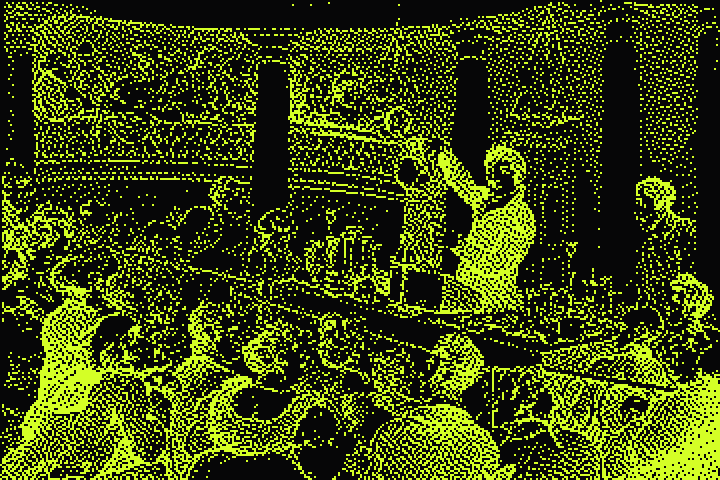
In February 1856 the Illustrated London News printed a wood engraving: Michael Faraday giving a demonstration at a Christmas Lecture at the Royal Institution in London, his left hand tossing something into the air, with Prince Albert and two of his sons in the front row.1 Science in those days had an audience. Over the century and more that followed, specialization brought science unprecedented success, but it also turned science into a walled city that most people cannot enter: papers are written for peers, the public stands outside the gates, and the disciplines eye one another across their walls. This essay traces the rise and fall of science’s audience, from anatomy theatres, amateurs and public lectures to the turn towards the “public understanding of science” and the revival of citizen science. My judgement is this: the age of AI offers a chance to bring the audience back and to put the work into amateurs’ hands again – but what should get easier is the doing, not the standard.
1What is there to watch in other people’s research?#
What is there to watch in other people’s research? More than a decade ago, people asked the same question about game streaming: would people really spend all day watching someone else play instead of playing themselves? The answer came quickly. Twitch, a site devoted to streaming games, went live in June 2011; three years later Amazon bought it for about $970 million in cash. The acquisition announcement noted that in July 2014 alone more than 55 million unique visitors had watched more than 15 billion minutes of content on the site, made by more than a million broadcasters; Jeff Bezos called broadcasting and watching gameplay “a global phenomenon”.2 That those who watch far outnumber those who play has long been common knowledge in any football stadium.
Go offers a more intriguing scene. In March 2016 AlphaGo beat Lee Sedol 4–1 in Seoul; by DeepMind’s count, more than 200 million people around the world watched the match.3 Since then it has been settled that machines play better than people. Yet people did not walk out: game commentary and post-game reviews have, if anything, become more popular. One study analysed more than 5.8 million moves made by professional players between 1950 and 2021, using a superhuman AI to score each one, and found that the quality of human decisions improved significantly after superhuman AI appeared; novel moves, never seen before, became more frequent and were associated with better decisions.4 The researchers suggest that the arrival of superhuman AI may have prompted players to break away from traditional play and boldly try new moves. From the contests of the Greeks to today’s esports, competitions have always been made to be watched.
Could science be watched like this too? It sounds fanciful, but it is nothing new: science always had an audience. The anatomy theatres of the late sixteenth century, the air-pump demonstrations of the seventeenth and the Christmas Lectures of the nineteenth were all public performances, and much of the science of those days was driven by enthusiasts who drew no salary. Later, specialization pushed the audience further and further away, shut amateurs out and cut the disciplines up into islands. The New Science Manifesto says that some play, and everyone can watch. Behind that sentence lies a long history, and it also calls for a sense of proportion: why the audience left its seats, why the public matters, and – once the audience returns – what will stop science from turning into a mere spectacle.
2Who was watching science four hundred years ago?#
In 1594 (some say 1596) Leiden University built an anatomy theatre. Tiers of seats rose in rings around the dissecting table at its centre. Dissections were held only in winter, when the cold kept the bodies from rotting too quickly – a few times a year, each lasting several days. The bodies were those of hanged criminals; in the seats sat students and surgeons, and also curious townspeople who had paid for admission. In summer, when there was no teaching, the theatre became a display room where visitors could admire marvels from distant lands, things they had never heard of.5 Here knowledge was teaching, but it was also a public ritual and an entertainment for the city: what the townspeople paid to see was the secrets of the human body laid open, layer by layer.
Sixty-odd years later, watching was put to more serious use. In the late 1650s Robert Boyle and his assistant Robert Hooke built an air pump in Oxford, and Boyle demonstrated what happens in a vacuum before a small group of like-minded natural philosophers.6 The historian of science Steven Shapin has shown that Boyle’s experimental reports spelled out details and circumstances at great length, so that readers who had not been present could rebuild the scene in their minds – what Shapin calls “virtual witnessing”.7 In Leviathan and the Air-Pump he and Simon Schaffer went further, arguing that experimental facts were produced by three “technologies” working together: material, literary and social.8 Witnessing was where the credibility of modern science began; the journal, born in 1665, simply carried witnessing further afield. Today, when text can be generated endlessly and cheaply, we need new technologies of witnessing.
By the eighteenth century, scientific demonstrations had become a fashionable entertainment in polite society. In 1746 the French physicist Jean-Antoine Nollet, known as the Abbé Nollet, discharged a Leyden jar through the entire community of the Carthusian monastery in Paris, the monks linked one to the next by iron wire in a line 900 toises (about 1.75 km) long. The monks twitched and leapt into the air at the same moment, from which he concluded that electricity travels astonishingly fast; he also had 180 guards hold hands in front of Louis XV and take the same shock.9 Joseph Wright of Derby’s famous painting of 1768, An Experiment on a Bird in the Air Pump, shows an itinerant lecturer performing an air-pump experiment by candlelight in a private house; men, women and children crowd round the table, some leaning in for a closer look, others unable to bear the sight. The National Gallery in London notes that the public of the time probably only encountered “science” through the demonstrations of travelling lecturers, usually in town halls or, as in the painting, privately by invitation.10
In the nineteenth century the lectern became more formal. The Royal Institution in London launched its Christmas Lectures in December 1825, the first series given by John Millington, its professor of mechanics. Two years later Faraday took the stage; he went on to give nineteen series in all, the last being The Chemical History of a Candle in 1860–61; published as a book, it is probably one of the most popular science books of all time. The tradition continues to this day: the lectures appeared on the BBC’s fledgling television service in 1936 and have been broadcast every year since 1966.11 The scene in the engraving at the start of this essay was one of them.1
In Berlin, Alexander von Humboldt carried the lectern out of the university. From November 1827 to April 1828 he gave 61 lectures on the cosmos at the University of Berlin, and at the same time 16 lectures for the general public at the Sing-Akademie next door. Each of these drew about a thousand listeners, from labourers, craftsmen and city councillors to members of the court – King Frederick William III and the crown prince came too – and among them were women, who at that time could not attend Prussian universities. Humboldt charged no admission and even paid for the hall himself. The lectures later grew into his five-volume magnum opus, Kosmos.12 Scenes like these remind us that science did not grow up behind closed doors. Its authority came partly from evidence and partly from demonstration in public; the audience was not decoration but part of the witnessing.
3Can amateurs move science forward?#
The word “amateur” comes, by way of French, from the Latin amator, “lover”.13 Before science became a profession, it was driven forward in large part by just such lovers. On the night of 13 March 1781 a musician in Bath, in England, was in his back garden with a telescope he had made himself when he found a slowly moving object in the sky: the first new planet discovered since antiquity.14 His name was William Herschel. He earned his living copying music, teaching, playing the organ and conducting, and in his spare time he built reflecting telescopes. At first he took the object for a comet; only later was it confirmed as a planet – Uranus. The Crown then granted him a pension of £200 a year, which allowed him to give up music and devote himself to astronomy;15 the sum was reportedly less than he had earned as a musician.16
His sister Caroline also began as a professional musician and later became his assistant: she ground mirrors, did calculations and kept house, and swept the night sky with a telescope of her own. In her lifetime she discovered eight comets. In 1787 King George III granted her a salary of £50 a year as her brother’s assistant, making her the first woman in Britain to be paid for scientific work.17 The Herschels’ path from enthusiasts to astronomers kept by the Crown captures in miniature the eve of professionalization: science was beginning to need people full-time, and beginning to pay them.
Charles Darwin never held a university post, yet he shaped the work of many naturalists: he started collaborations, suggested experiments and even inspired whole research programmes.18 He wove a network out of letters. The correspondence collected today runs to more than 15,000 letters, involving more than 2,000 correspondents and people mentioned in them.19 The network included eminent figures such as the botanist Asa Gray, but also pigeon fanciers and dog breeders he was introduced to, the Scottish gardener John Scott, and women amateur botanists such as Lydia Becker and Mary Barber. He asked them for data and asked them to run experiments, and most of them he never met.18 Nineteenth-century natural history was, by its very nature, a web woven from specimens, letters and enthusiasts.
Mary Anning’s story shows another side of the amateur. Born in 1799 in Lyme Regis, a small seaside town on the south coast of England, she made her living by digging up, cleaning and selling fossils. In the autumn of 1811 her brother Joseph found the skull of an ichthyosaur; about a year later she found the rest of it, and spent months digging out the whole five-metre skeleton. In 1823 she found the first complete plesiosaur skeleton, which even Georges Cuvier at first suspected was a fake pieced together from parts; in 1828 she found the first pterosaur fossil discovered outside Germany. Yet the Geological Society of London would not admit her, and the gentlemen scholars who bought her fossils often left her name out of their papers.20 The Society admitted its first women Fellows only on 21 May 1919 – Anning’s birthday, as it happened, and seventy-two years after her death.21
The enthusiasts have not disappeared. On 19 May 2023 the Japanese amateur astronomer Koichi Itagaki discovered the supernova SN 2023ixf in the Pinwheel Galaxy, M101 – the second-closest supernova to Earth in a decade. Since taking up the hobby in 2000, he had by then discovered 172 supernovae.22 That August another Japanese amateur, Hideo Nishimura, used an ordinary digital camera and a 30-second exposure to capture a new comet that was later named after him.23 However powerful professional sky surveys become, the sky is big enough to need countless amateur eyes. In a field like astronomy, amateurs have never been mere spectators; they are part of the whole observing network.
4How was the public ushered out of the stands?#
The word “scientist” is itself a product of specialization. In June 1833, at the annual meeting of the British Association for the Advancement of Science, the poet Samuel Taylor Coleridge objected from the floor: men who dug in fossil pits and fiddled with electrical apparatus could not lay claim to the title of “natural philosopher”. William Whewell of Trinity College, Cambridge, rose to suggest that, by analogy with “artist”, they might coin the word “scientist”.24 The word first appeared in print in 1834; in 1840, in The Philosophy of the Inductive Sciences, Whewell made the case again: “We need very much a name to describe a cultivator of science in general. I should incline to call him a Scientist.”25
Behind the name stood a whole system of institutions. Around 1810 Alexander’s elder brother, Wilhelm von Humboldt, led the founding of the University of Berlin, which combined a modern curriculum and free inquiry unconstrained by dogma with specialized scientific institutes; many basic laboratory techniques took shape there.26 Justus von Liebig built a teaching laboratory at the University of Giessen that trained graduate students in large numbers, a model widely copied, first in Europe and later in the United States.27 Research universities, doctorates, laboratories, professional societies and specialist journals grew together into their present form in the nineteenth century. Science became a profession, and the paper became that profession’s standard output; for how the profession turned, step by step, into an assembly line, see The Academic Assembly Line. Specialization brought unprecedented success: the division of labour let knowledge accumulate faster than ever before, and many achievements of the modern chemical and electrical industries and of medicine would have been impossible without this system.
On 7 November 1917 Max Weber gave a lecture to students in Munich, “Wissenschaft als Beruf” (“Science as a Vocation”), in which he coolly acknowledged the logic of specialization. Science, he said, had entered a stage of specialization unknown in the past, and it would remain so for all time to come; only through strict specialization could a scholar truly experience that sense of fulfilment which may come once in a lifetime and perhaps never again: “Here I have achieved something that will last.” He admitted, too, that all work that strays into neighbouring fields is burdened with a resigned awareness: at best it supplies the specialist with some useful questions, while one’s own work is bound to remain highly imperfect.28 He asked scholars to put on “blinkers” and pour all their passion into whether a single emendation in a manuscript is right. This is the ethic of specialization, and also its price.
Others saw mainly the price. In 1930 José Ortega y Gasset devoted a chapter of The Revolt of the Masses to “The Barbarism of ‘Specialisation’”: the specialist knows his own tiny corner of the universe intimately and is ignorant of everything else, yet he pronounces on politics, art and social questions with all the conceit of the expert. Ortega called such a person a “learned ignoramus”.29 On 7 May 1959, in the Rede Lecture at Cambridge, C. P. Snow put forward the idea of “two cultures”. He recalled having once asked a gathering of literary people how many of them could describe the second law of thermodynamics: “The response was cold: it was also negative. Yet I was asking something which is about the scientific equivalent of: Have you read a work of Shakespeare’s?”30
But Snow’s problem, I would argue, is long out of date. What he described was nothing more than the old habit of “literati disparaging one another” – in this case between literary intellectuals and scientists – a struggle within the elite over who gets to speak. Sixty-odd years on, the elite’s pecking orders of contempt have multiplied: physics looks down on psychology, and continental and Anglo-American philosophers ignore each other – far more than “two cultures” can capture. The real rift lies between elite culture and mass culture. Today’s public cares about neither Shakespeare nor the second law of thermodynamics, while an intellectual elite long since pushed to the margins still agonizes over science versus literature – like banished consorts still scheming against one another in the cold palace.31
The price can also be measured. One study analysed more than 700,000 abstracts from 123 journals published between 1881 and 2015 and found that the readability of scientific texts has declined steadily: in 1960, 14% of abstracts were too difficult for a college graduate to read; by 2015 the figure had risen to 22%, driven mainly by a growing use of general scientific jargon.32 The economist Benjamin Jones calls the mechanism behind this “the burden of knowledge”: the more knowledge accumulates, the more each newcomer has to learn, so specialties are cut ever finer and research leans ever more on teams.33 So the paper became a narrow-necked bottle: peers read it quickly, but beginners, readers from other disciplines and the public cannot squeeze through the neck. The public is out of the game, and scholars each guard their own island.
5Is it knowledge that the public lacks?#
The scientific community did notice that the public had been pushed out of the stands. In 1985 the Royal Society published The Public Understanding of Science, a report produced under the chairmanship of Sir Walter Bodmer. Better public understanding, it argued, could promote national prosperity, raise the quality of public and private decision-making and enrich the lives of individuals; and its most direct and urgent message was addressed to scientists: “Scientists must learn to communicate with the public, be willing to do so, and indeed consider it their duty to do so.”34 The report paved the way for the expansion of science communication that followed, and science grew more visible in culture and the media; the Royal Society has announced that it will revisit the report’s themes in its 2026 Science for society report.34
Critics later called this way of thinking the “deficit model”: public doubts about science stem from a lack of knowledge, so fill the gap with remedial lessons, and understanding and support will follow. The trouble with the deficit model is not whether ordinary people really lack knowledge – on specialist matters their opinions are often riddled with errors, and there is no need to pretend otherwise – but that it treats them as passive ignoramuses, and treats popular science as a one-way delivery from on high. A meta-analysis pooling 193 national surveys in 40 countries found that there is indeed a positive correlation between scientific knowledge and general attitudes towards science, but that it is small, and that it varies more between specific fields than across cultures.35 Knowing a little more does not necessarily mean supporting science more. The reasons for public distrust often lie not in knowledge but in the scientific community itself: scientists’ statements may be controlled, selection processes may be dubious, accepted rules may be dropped at a moment’s notice – and when something goes wrong, the popularizers who were so busy “debunking rumours” fall silent. Is that really just the public’s fault?36
The sociologist Brian Wynne’s study of sheep farmers in Cumbria, England, makes the point most clearly. After the Chernobyl accident in 1986, radioactive caesium fell on the upland pastures of the Lake District. On 20 June the government banned the sale of sheep from the area, and scientists confidently assured farmers that the raised caesium levels in the animals would last only about three weeks. Three weeks passed, and the ban became indefinite. It turned out that the scientists’ predictions had relied on a model for alkaline clay soils, in which caesium is locked up; the Lake District fells, however, have acid peaty soils, in which caesium remains mobile – taken up by the roots of the grass, eaten by the sheep, and round again, cycle after cycle.37
The farmers’ own knowledge was brushed aside as well. Scientists penned sheep in experimental plots on the fells to test the effect of bentonite; the farmers warned that sheep lose condition as soon as they are penned, which would invalidate the experiments. The experiments were later quietly abandoned – for exactly the reason the farmers had given.37 The restrictions in the UK were not fully lifted until 2012, twenty-six years later; at the outset some 9,800 farms and more than four million sheep had been affected.38 Wynne called his paper “Misunderstood Misunderstanding”. The sheep farmers did not lack knowledge; what they lacked was having their knowledge treated as knowledge.
British policymakers took more than a decade to take this in. In February 2000 the House of Lords Select Committee on Science and Technology published its report Science and Society. It opened by observing that a series of events, culminating in the BSE crisis, had shaken public confidence in scientific advice to government. The report quoted Robert May describing “public understanding of science” as a “rather backward-looking vision”, and recommended that direct dialogue with the public should move from being an “optional add-on” to science-based policy-making to “a normal and integral part” of the process.39 In 2004 a report from the think tank Demos went further, arguing that public engagement needed to “move upstream”, entering while the direction and uses of research were still taking shape.40
A warning from the opposite direction soon followed. In 2002 Harry Collins and Robert Evans proposed a “third wave” of science studies. If participation is widened indiscriminately in the name of legitimacy, they argued, the line between experts and non-experts disappears, creating the “problem of extension”: how far, in the end, should participation in technical decision-making extend? They distinguished the expertise needed to contribute to a field from “interactional expertise” – the ability to hold a meaningful conversation with insiders without directly producing new knowledge.41 The distinction matters: widening participation does not mean that everyone gets the final say on every technical question. But where the line is drawn depends on what people care about. What people care about is nuclear radiation, not scientific knowledge, and radiation does not play politics with us: radiation leaked through an administrator’s mistake is no gentler than radiation leaked through a scientific error. In this sense people have every right to “lump science and politics together” – indeed they must – and to answer them it is nowhere near enough to stand inside scientific knowledge alone.36
China has taken a road built around kepu, or “science popularization”. On 29 June 2002 the Standing Committee of the National People’s Congress passed the Law on the Popularization of Science and Technology; the version revised on 25 December 2024 states that the state places science popularization on a par with scientific and technological innovation.42 According to sample surveys organized by the China Association for Science and Technology, the share of Chinese citizens who are scientifically literate rose from 10.56% in 2020 to 16.74% in 2025 (among 18- to 69-year-olds), the share with at least basic scientific literacy (a test score of 55 or more, a group that includes the 16.74%) reached 49.02%, and Beijing and Shanghai passed 30% for the first time.4344 The numbers are rising, but indicators like these measure exactly what the deficit model cares about – how much the public knows. They rarely ask what the public wants to say, or whether anyone listens when it does. There is still a step to take from popularization to participation. For my part, I would like to put in a contrarian word for kepu: popularization need not march under the banner of “innovation”; it should stand, unapologetically, on the opposite side – looking backwards, fully digesting and consolidating the innovations of earlier generations, turning them into common sense and then into old dogmas waiting to be overthrown. What the ancient Chinese lacked was never innovative minds, but an environment in which innovation could be digested.45 Forty years after the Bodmer report, the question is shifting from “Does the public understand science?” to “Does science listen to the public?”
6Has the audience come back?#
Meanwhile another thread was quietly growing. Citizen science is much older than its name. On Christmas Day 1900 the ornithologist Frank Chapman proposed “counting birds” in place of the Christmas “side hunt”, a shooting competition then in fashion; that year 27 birdwatchers at 25 locations in North America carried out the first Christmas Bird Count, and today tens of thousands of volunteers take part every winter.46 In May 1999 Berkeley’s SETI@home went live, asking volunteers around the world to lend their home computers’ idle processing power to analysing radio-telescope data; it has since gone into hibernation and no longer sends out work.47 In 2002 the Cornell Lab of Ornithology and the National Audubon Society launched eBird,48 which now receives more than 100 million bird sightings a year.49
The real turning point came in 2007. Galaxy Zoo, launched that year, asked the public to help classify galaxies photographed by the Sloan Digital Sky Survey. According to its first paper, published in 2008, some 100,000 volunteers made more than 40 million classifications of nearly a million galaxies, and their results agreed with those of professional astronomers.50 Also in 2007, a Dutch schoolteacher, Hanny van Arkel, noticed a strange green cloud of gas in one of the images. The object, later known as Hanny’s Voorwerp (voorwerp is simply Dutch for “object”), turned out to be a cloud of gas the size of the Milky Way, lit up by a quasar;51 she herself is among the authors of the paper on it.52
Games joined in too. In 2008 the University of Washington released Foldit, a protein-folding game.53 In 2011 researchers handed players the puzzle of the structure of a retroviral protease from a monkey virus, a problem that had defeated scientists for years. In less than three weeks the players produced a model good enough for the structure to be solved, and the player teams were credited as authors of the paper.5455 In 2014 a paper in PNAS listed the players of the RNA-design game EteRNA as a collective author, “EteRNA Participants”; the project then connected 37,000 enthusiasts.56 Mathematicians have tried it too. In early 2009 the Fields Medallist Timothy Gowers launched the Polymath Project on his blog, inviting anyone to collaborate in the comments on a hard problem in combinatorics. About a month later, with the comment count approaching a thousand, he announced that he was “basically sure” the problem had been solved. Professional mathematicians such as Terence Tao had taken part, along with a number of amateurs.5758
Zooniverse, the platform that grew out of Galaxy Zoo, had by June 2026 brought together more than three million volunteers, who between them had made a billion classifications.59 The Vesuvius Challenge, launched in March 2023, offered prizes to anyone who could use machine learning to read the Herculaneum scrolls carbonized by the eruption of Vesuvius. That October a competitor, Luke Farritor, read the first complete word from an unopened scroll: ΠΟΡΦΥΡΑϹ, “purple”. In February 2024 Farritor, Youssef Nader and Julian Schilliger shared the $700,000 grand prize for reading more than 2,000 characters, about 5% of the scroll;60 and in 2026 PHerc. 1667 became the first Herculaneum scroll to be virtually unrolled in full and read from beginning to end.61 It was a rare crowdsourcing moment for the humanities.
The latest example comes from mathematics. In April 2026 a 23-year-old with no professional training in mathematics used GPT-5.4 Pro to solve an Erdős problem that had stood open for sixty years;62 by August, 565 problems on erdosproblems.com were marked as solved, with amateurs, professional mathematicians and AI working together in the same comment threads.63 What these projects have in common is not that they make science simpler. They break a big task into many small ones that many people can do, while keeping mechanisms for checking the work: each galaxy is judged independently by many people, Foldit’s models have to pass the test of crystallographic data, and the rough proofs that AI produces have to be polished and checked by mathematicians. The revival of citizen science is, in truth, a revival of the division of roles.
7Why are we laypeople even in the discipline next door?#
Specialization cut the disciplines into islands, yet many important breakthroughs have happened precisely between the islands. In February 1943 Erwin Schrödinger, one of the founders of quantum mechanics, gave a series of public lectures at Trinity College Dublin, published the following year as the slim book What Is Life? Here was a physicist pressing on the central question of biology: how is hereditary information stably stored and passed on at the molecular scale? He suggested that the genetic material was an “aperiodic crystal”.64 In 2018, on the lectures’ 75th anniversary, Nature published an article saying that they had crystallized some key concepts of modern molecular biology.65
A decade after the lectures, the riddle was solved in Cambridge. On 25 April 1953 Nature published James Watson and Francis Crick’s double-helix model of DNA.66 Their own backgrounds crossed disciplines. Crick had read physics at University College London and spent the war at the Admiralty working on magnetic and acoustic mines, leaving only in 1947 to turn to biology. Watson, a zoology graduate of the University of Chicago, had come to genetics by way of a boyhood passion for birdwatching; his doctoral thesis was on the effect of hard X-rays on the multiplication of bacteriophages.6768 Diffraction patterns from physics, molecular models from chemistry and the problem of heredity from biology met in a single model.
Crucial data for the model came from Rosalind Franklin’s X-ray crystallography at King’s College London: she distinguished the A and B forms of DNA and determined the dimensions and symmetry of its unit cell. In 2023, drawing on newly discovered archival material, Matthew Cobb and Nathaniel Comfort argued that Franklin was an equal contributor to the discovery, not the victim of popular legend whose data were stolen and who failed to understand her own photograph; Watson and Crick themselves wrote in 1954 that without Franklin’s data the formulation of their structure would have been “most unlikely, if not impossible”.69 Interdisciplinary collaboration has never been just a matter of piecing knowledge together; it is also about whose contributions get seen.
Interdisciplinarity can also be institutionalized. In 1984 a group of scientists, most of them from Los Alamos National Laboratory, founded the Santa Fe Institute in New Mexico, precisely in response to what they saw as the growing specialization of science, to study complex systems beyond the boundaries of academic departments;70 the institute still describes itself as “an institution without fiefdoms”.71 In 1994 Michael Gibbons and five co-authors proposed “Mode 2” in The New Production of Knowledge: knowledge produced in a broader social context – transdisciplinary, heterogeneous and reflexive – as opposed to traditional knowledge production organized by discipline.72 But institutions are not always friendly. An analysis of 18,476 grant applications to the Australian Research Council between 2010 and 2014 found that the more interdisciplinary a proposal was, the lower its chances of being funded.73
Climate change, pandemics and the governance of artificial intelligence have never respected the division into departments. AI makes “translation” across fields cheap: a biologist can ask a model to explain a piece of topology, a historian can ask it to make sense of a statistics paper. But cheap translation can also mean skimming the surface. A study of 41.3 million papers found that scientists who use AI publish 3.02 times as many papers as others, receive 4.84 times as many citations and become project leaders 1.37 years earlier; yet taken as a whole, AI has shrunk the range of topics that science covers by 4.63% and reduced scientists’ engagement with one another by 22%. It is automating established fields more than it is opening up new ones.74
Lisa Messeri and Molly Crockett warn that AI may give researchers “illusions of understanding” and encourage “monocultures” of methods and viewpoints, so that we “produce more but understand less”.75 What interdisciplinary work really lacks is not faster translation but people who can bring judgements from different fields together, explain them clearly and stand up to questioning. That is exactly the work of a curator, and it is also what makes it possible for the public to come in: a result that cannot be explained even to the discipline next door is even less likely to be explained to the public; conversely, being able to explain it to the public is often the touchstone of real understanding. The pecking order of disciplines is especially harsh in China: programmers trained as engineers look down on the humanities as nothing but empty phrases, stock formulas and talk that goes round in circles, while humanities scholars take no interest in the frontiers of science and technology and bury themselves in old texts.76 Breaking down the wall between the sciences and the humanities is not about producing a few more interdisciplinary papers; it is about making citizens who can argue. What the age of AI needs to revive is precisely liberal education, an education in the liberal arts.77
8Why does the public matter?#
Why does the public matter? The plainest reasons are money and mandate: much of modern science is paid for out of public funds, and its autonomy rests on a mandate from the public. That mandate has not vanished. A survey published in 2025, covering 71,922 respondents in 68 countries, found that trust in scientists is moderately high overall, averaging 3.62 on a five-point scale; 83% of respondents think scientists should communicate about science with the public, and only 21% disagree that scientists should be more involved in policymaking.78 But trust is uneven, and markedly lower in some countries and groups; the researchers caution that a lack of trust among even a small minority may affect how scientific evidence is taken up in policymaking.
The pandemic laid this fragility bare. The World Health Organization calls the flood of information during an epidemic an “infodemic”: too much information in digital and physical environments during a disease outbreak, including false or misleading information, which causes confusion and risk-taking behaviour and erodes trust in health authorities. The first item on the WHO’s list of responses is not debunking rumours but listening to communities’ concerns and questions.79 One-way communication cannot fill a vacuum of trust. Let me go a step further. What we call rumour is, by its nature, the way ordinary people speak, as opposed to official voices – how else are they to speak? Through a few “representatives of public opinion”? Such people are often closer to the elite than to the public. To respect people’s voices, professionals have to learn to respond to the constructive force within rumours; and “constructive” was never meant to be a demand made of the speaker, but of the listener. When a diner complains “Too salty!” and the cook uses less salt next time, the complaint has become constructive. Complaints, panic and suspicion are like pain and itching: look for the cause first, rather than rushing to stop the itch.36
The public brings something else as well: epistemic diversity. The Cumbrian sheep farmers knew their fells and their sheep; that knowledge was in no paper, yet it decided whether an experiment could work. The AIDS movement in the United States went further. In Impure Science the sociologist Steven Epstein records how AIDS activists who had not been trained as scientists won credibility through novel strategies, shaped research funded by the National Institutes of Health (NIH) to a remarkable degree, and changed the practice of biomedical research, clinical trials included. He also cautions that every social movement that tries to democratize expertise runs into unusual difficulties.80
At a deeper level the question concerns democracy itself, and here there is a tension worth revisiting. In 1927 John Dewey wrote in The Public and Its Problems: “The man who wears the shoe knows best that it pinches and where it pinches, even if the expert shoemaker is the best judge of how the trouble is to be remedied.” He warned that a class of experts is inevitably so removed from common interests as to become a class with private interests and private knowledge, “which in social matters is not knowledge at all”.81 Thirty-five years later, in “The Republic of Science”, Michael Polanyi argued from the other end. The republic of science, he wrote, is a “Society of Explorers”: independent explorers adjust to one another and are coordinated, as in a market, by an “invisible hand”. Direction from outside can only harm it: “You can kill or mutilate the advance of science, you cannot shape it.” And the body of scientists as a whole upholds precisely the authority of science over the lay public.82
Each was half right. Polanyi reminds us that whether a proof is correct, or whether an experiment stands up, must be left to competent peers; it cannot be put to a vote. Dewey reminds us that which questions deserve research, which risks are acceptable and on whom the consequences of research fall cannot be left to experts alone. Public understanding of science, then, should not be one-way education but participation in judgement – in the judgements the public ought to share in anyway. Trust cannot be won by propaganda; it can only be earned, bit by bit, through evidence you can open and results that survive replication. That is the lesson of the replication crisis, and it is what the new science hopes to rebuild: standards and reputation.
9Will live streams, games and AI bring the audience back?#
Back to the question we started with. Suppose research could unfold like a turn-based game: the researcher writes a direction file, the AI party plays a turn and hands back a battle report setting out progress, evidence, risks and the branches on offer. Then the audience would have something to watch. They could follow a whole game of research, raise questions and suggestions in live comments, vote on which branch to take next turn, or tip a small study the resources it needs to get started. The audience may not contribute anything substantive, but feedback is itself a contribution: feedback gives a sense of reality. Anyone who has taught knows that nothing lifts you like a knowing smile from a student, while lecturing online to a blank wall feels emptier the longer it goes on. For science, the audience’s return carries a further meaning: when every turn of research is seen, it becomes harder for science to hide behind the paper.
But letting the audience take the controls directly calls for careful design. On 12 February 2014 an anonymous Australian programmer opened a channel on Twitch that let viewers type button commands into the chat box and so play a game of Pokémon Red collectively. After more than sixteen days of continuous streaming the game was completed, by which point an estimated 1.16 million people or more had joined in; but the process was famously chaotic, the hero often stuck in a corner, going round in circles. Less than a week after the stream began, the channel introduced a “democracy mode” in which commands were put to a vote before being carried out – which in turn stirred up controversy among the players.83 The experiment illustrates a design principle: the audience’s voice should first go into the “atmosphere layer” of the battle report and become an instruction only once a researcher adopts it; participation can be collective, but responsibility must rest with particular people. Good game design has always been about striking a balance between freedom and rules.
Crowds can also amplify hype. In late July 2023 a team in South Korea claimed in a preprint to have found LK-99, a superconductor that works at room temperature and ambient pressure. The news went viral on social media, and scientists and amateurs alike rushed to replicate the result, but the early attempts all failed.84 On 16 August Nature reported that the replication efforts had pieced together the answer: LK-99 is not a superconductor.85 Half of this spectacle was noise, half was science. The hype came fast, and so did the correction – fast because the preprints, the data and the replication attempts were mostly out in the open. Conversely, if watching turns into nothing but noise, correction will be drowned out.
AI could also become every viewer’s personal guide: breaking a proof into steps, turning a chart into a story, patiently answering a layperson’s most basic follow-up questions. But the risks are just as clear. The guide can itself be wrong, and the feeling of having understood is not the same as understanding: the “illusions of understanding” that Messeri and Crockett describe apply to audiences too.75 Some worry that turning research into entertainment will reward the research that performs best rather than the research that is soundest. I do not see this as a danger. Tipping on live streams already rewards whoever brings people the most delight – which is exactly what distribution according to delight looks like;86 the real diseases of social media are anti-intellectualism, polarization and extremism, and by comparison the entertainment that Neil Postman so abhorred hardly even counts as bad.87 Nor are research that performs well and research that is sound opposed: good commentary on a game of Go has never kept anyone from playing well. What we really have to guard against is work that nobody checks. The more results AI generates, the more there is that nobody checks. Thomas Bloom, who founded the Erdős problems website, worries: “AI is being used a lot by people who aren’t mathematicians … no human has read it, and no human is going to read it.”63 In September 2026 more than 700 people signed an open letter opposing a forty-hour AI “Mathathon”, arguing that rushing large models at open problems would only produce “slop mathematics” and shift the burden of verification onto the community.88 At the end of the month the event was redesigned to seek new proofs and explanations of existing theorems instead, and would no longer accept sponsorship from developers of proprietary AI models.89
10If anyone can take part, who keeps the gate?#
So the audience’s return must go hand in hand with a division of roles. The New Science Manifesto imagines five positions for people. The Terminator decides when to call a halt. The Commander points the AI in a direction and marks out no-go zones. The Warden keeps watch over ethics, funding and disclosure. The Dreamer throws out ideas and leaves the AI to fill in the details and test them. The Audience, the largest group, watches, asks questions, votes and tips – and acts as a watchdog too. This does not turn science into a democratic vote. Polanyi was right that whether a proof is correct cannot be put to a vote; Dewey was right, too, that whether the shoe pinches, the wearer knows best. Dividing the roles means letting each kind of judgement fall to people who are able, and willing, to bear it.
Once the roles are divided, the standards must be clearer. The new science sets itself three rules. Evidence you can open: everything that enters the evidence layer must have traceable sources, data and code. Results someone can explain: Terence Tao says that a proof no human can properly explain should be viewed as incomplete, even if it has been formally verified.90 AI use in plain sight: which model was used, and what it did, must be disclosed. The Leiden Declaration, published in 2026, makes similar demands of the mathematical community – disclose the tools you use, and leave authorship and responsibility with people; it welcomes the community’s growth while asking newcomers to respect its values.91
Galaxy Zoo showed how this works long ago. Volunteers did not need to understand galaxy evolution, only to judge what the galaxy in front of them looked like; each galaxy was given to many people to judge independently, and researchers then pooled and checked the results, which agreed with professional classifications.50 What gets easier is the doing, not the standard. Decentralization is not flattening; on the contrary, it is often centralization that leads to flatness. We need city walls, and we need gates, and the gates need thresholds: openness and barriers go hand in hand.92 Public participation does not mean lowering the threshold; it means opening entrances – so that the townspeople in the anatomy theatre, the musician in his back garden, the girl digging fossils on the beach, and everyone in front of a screen today can each find a place: standing to watch, sitting down to ask, or rolling up their sleeves to do.
※Sources
- 1
Illustrated London News, “Michael Faraday lecturing at the Royal Institution: Prince Albert and his sons in the audience”, wood engraving after a painting by A. Blaikley, 16 February 1856 (Wellcome Collection). wellcomecollection.org/works/h5thrnzb ↩↩2
- 2
Amazon.com, Inc., “Amazon.com to Acquire Twitch”, Business Wire / Amazon press centre, 25 August 2014. press.aboutamazon.com/2014/8/amazon-com-to-acquire-twitch ↩
- 3
Google DeepMind, “AlphaGo”, research breakthroughs page, DeepMind website, accessed September 2026. deepmind.google/research/breakthroughs/alphago/ ↩
- 4
Minkyu Shin, Jin Kim, Bas van Opheusden & Thomas L. Griffiths, “Superhuman artificial intelligence can improve human decision-making by increasing novelty”, PNAS 120, no. 12 (2023): e2214840120. doi.org/10.1073/pnas.2214840120 ↩
- 5
Rijksmuseum Boerhaave, “Anatomical Theatre”, website of the Rijksmuseum Boerhaave, Leiden, accessed September 2026. rijksmuseumboerhaave.nl/en/our-worlds/anatomical-theatre ↩
- 6
Science History Institute, “Pumped Up”, Distillations, 18 July 2014. sciencehistory.org/stories/magazine/pumped-up ↩
- 7
Steven Shapin, “Pump and Circumstance: Robert Boyle’s Literary Technology”, Social Studies of Science 14, no. 4 (1984): 481–520. doi.org/10.1177/030631284014004001 ↩
- 8
Steven Shapin & Simon Schaffer, Leviathan and the Air-Pump: Hobbes, Boyle, and the Experimental Life (Princeton University Press, 1985). press.princeton.edu/books/paperback/9780691178165/leviathan-a… ↩
- 9
Joseph Priestley, The History and Present State of Electricity (London, 1767), which describes both demonstrations, the Carthusians of Paris and the 180 guards; for a modern retelling see Institute of Physics, “Electric monks”, IOPSpark, accessed September 2026 (which gives about two hundred monks in a circle some 1.6 km round). archive.org/details/10058663bsb ; spark.iop.org/electric-monks ↩
- 10
The National Gallery, London, Joseph Wright ‘of Derby’, An Experiment on a Bird in the Air Pump, 1768 (collection entry). nationalgallery.org.uk/paintings/joseph-wright-of-derby-an-ex… ↩
- 11
The Royal Institution, “The origin of the CHRISTMAS LECTURES”, in “Watch the Royal Institution CHRISTMAS LECTURES archive”, accessed September 2026. rigb.org/christmas-lectures/watch-royal-institution-christmas… ↩
- 12
Humboldt Forum, “Humboldt’s Cosmos”, Humboldt Forum Magazine, accessed September 2026. humboldtforum.org/en/magazine/article/humboldts-cosmos ↩
- 13
Online Etymology Dictionary, “amateur”, accessed September 2026. etymonline.com/word/amateur ↩
- 14
The William Herschel Society, “The Herschels”, accessed September 2026. herschelsociety.org.uk/herschel/ ↩
- 15
Nationale Akademie der Wissenschaften Leopoldina, “Sir William Herschel” (member profile), accessed September 2026. leopoldina.org/en/members/member-list/detail/sir-william-hers… ↩
- 16
Smithsonian Magazine, “The Georgian Planet: A Case of Clever Marketing”, accessed September 2026. smithsonianmag.com/science-nature/the-georgian-planet-a-case-… ↩
- 17
Royal Museums Greenwich, “Caroline Herschel: the first paid female astronomer”, accessed September 2026. rmg.co.uk/stories/space-astronomy/caroline-herschel-first-pai… ↩
- 18
Darwin Correspondence Project, “Scientific networks”, University of Cambridge, accessed September 2026. darwinproject.ac.uk/learning/universities/letters-primary-sou… ↩↩2
- 19
Department of History and Philosophy of Science, University of Cambridge, “The Darwin Correspondence Project”, accessed September 2026. hps.cam.ac.uk/research/projects/darwin-correspondence ↩
- 20
Natural History Museum, London, “Mary Anning: the unsung hero of palaeontology”, accessed September 2026. nhm.ac.uk/discover/mary-anning-unsung-hero.html ↩
- 21
The Geological Society of London, “Geological Society of London marks 100 years of female Fellowship”, 2019. geolsoc.org.uk/About/Press-Office/Press-Releases/Geological-S… ↩
- 22
Scientific American, “Astronomers Have Spotted a Once-in-a-Decade Supernova—and You Can, Too”, 2023. scientificamerican.com/article/astronomers-have-spotted-a-onc… ↩
- 23
NASA, “APOD: 2023 August 21 – Introducing Comet Nishimura”, 2023. science.nasa.gov/image-article/apod-2023-august-21-introducin… ↩
- 24
Laura J. Snyder, “Inventing the Scientist”, 2011 (the author also wrote The Philosophical Breakfast Club, 2011). laurajsnyder.com/2011/01/inventing-the-scientist/ ↩
- 25
Online Etymology Dictionary, “scientist” (quoting William Whewell, The Philosophy of the Inductive Sciences, 1840), accessed September 2026. etymonline.com/word/scientist ↩
- 26
Encyclopaedia Britannica, “Humboldt University of Berlin”, accessed September 2026. britannica.com/topic/Humboldt-University-of-Berlin ↩
- 27
Science History Institute, “Justus von Liebig and Friedrich Wöhler”, accessed September 2026. sciencehistory.org/historical-profile/justus-von-liebig-and-f… ↩
- 28
Max Weber, “Wissenschaft als Beruf” (lecture given in Munich on 7 November 1917, published 1919); German text from zeno.org; the quotations in the essay are translated from the German original. zeno.org/Soziologie/M/Weber,+Max/Schriften+zur+Wissenschaftsl… ↩
- 29
José Ortega y Gasset, La rebelión de las masas (1930); English translation The Revolt of the Masses, chapter 12, “The Barbarism of ‘Specialisation’”. ellopos.net/notebook/masses/gassett-masses-12.asp ↩
- 30
C. P. Snow, The Two Cultures (Rede Lecture, Cambridge, 7 May 1959) (Cambridge University Press, Canto edition with an introduction by Stefan Collini, 1993). doi.org/10.1017/CBO9780511819940 ↩
- 31
Hu Yilin 胡翌霖, 《“两种文化”之争早过时了》 [The “two cultures” debate is long out of date], Suixuan 随轩 (yilinhut.net), 2 July 2019. yilinhut.net/2019/07/02/7620.html ↩
- 32
Pontus Plavén-Sigray, Granville J. Matheson, Björn C. Schiffler & William H. Thompson, “The readability of scientific texts is decreasing over time”, eLife 6 (2017): e27725. doi.org/10.7554/eLife.27725 ↩
- 33
Benjamin F. Jones, “The Burden of Knowledge and the ‘Death of the Renaissance Man’: Is Innovation Getting Harder?”, Review of Economic Studies 76, no. 1 (2009): 283–317. doi.org/10.1111/j.1467-937X.2008.00531.x ↩
- 34
The Royal Society, The Public Understanding of Science (the Bodmer report), 1985; the Society’s page also notes that it will revisit the report’s themes in its 2026 Science for society report. royalsociety.org/news-resources/publications/1985/public-unde… ↩↩2
- 35
Nick Allum, Patrick Sturgis, Dimitra Tabourazi & Ian Brunton-Smith, “Science knowledge and attitudes across cultures: a meta-analysis”, Public Understanding of Science 17, no. 1 (2008): 35–54. doi.org/10.1177/0963662506070159 ↩
- 36
Hu Yilin 胡翌霖, 《“混为一谈”的意义:民众如何参与科学交流》 [The point of “lumping things together”: how ordinary people can take part in science communication], Suixuan 随轩 (yilinhut.net), 6 February 2020. yilinhut.net/2020/02/06/7848.html ↩↩2↩3
- 37
Brian Wynne, “Misunderstood misunderstanding: social identities and public uptake of science”, Public Understanding of Science 1, no. 3 (1992): 281–304. doi.org/10.1088/0963-6625/1/3/004 ↩↩2
- 38
UPI (republished by Space Daily), “U.K. lifts Chernobyl restrictions on sheep”, 23 March 2012. solardaily.com/reports/UK_lifts_Chernobyl_restrictions_on_she… ↩
- 39
House of Lords Select Committee on Science and Technology, Third Report: Science and Society (HL Paper 38), 23 February 2000. publications.parliament.uk/pa/ld199900/ldselect/ldsctech/38/3… ↩
- 40
James Wilsdon & Rebecca Willis, See-through Science: Why Public Engagement Needs to Move Upstream (Demos, 2004). sro.sussex.ac.uk/id/eprint/47855/ ↩
- 41
H. M. Collins & Robert Evans, “The Third Wave of Science Studies: Studies of Expertise and Experience”, Social Studies of Science 32, no. 2 (2002): 235–296. doi.org/10.1177/0306312702032002003 ↩
- 42
Xinhua News Agency 新华社, 《中华人民共和国科学技术普及法》 [Law of the People’s Republic of China on the Popularization of Science and Technology] (adopted 29 June 2002; revised 25 December 2024 at the 13th session of the Standing Committee of the 14th National People’s Congress), 2024. news.cn/politics/20241225/7d194f6bb04a453a824e7c3d68647480/c.… ↩
- 43
Guangming Online 光明网, 《我国公民具备科学素质比例超 10% 意味着什么》 [What it means that more than 10% of Chinese citizens are scientifically literate] (the 11th sample survey of Chinese citizens’ scientific literacy), January 2021. m.gmw.cn/baijia/2021-01/29/34581714.html ↩
- 44
Science and Technology Daily 科技日报, 《〈全国科普事业发展报告(2026)〉发布 我国公民具备科学素质比例达 16.74%》 [Report on the Development of Science Popularization in China (2026) released: 16.74% of Chinese citizens are scientifically literate], 29 September 2026; see also China Association for Science and Technology 中国科协, 《2025 年我国公民具备科学素质的比例达到 16.74%》 [In 2025, 16.74% of Chinese citizens were scientifically literate], 2026 (the figure first appeared in the National Bureau of Statistics’ statistical communiqué for 2025, published on 28 February 2026); for what “basic” literacy measures, see 中国科协之声 [Voice of CAST], 《49.02%,这一指标已近半数!》 [49.02%: this indicator is close to half], 11 September 2026 (reposted on Tencent News). stdaily.com/web/gdxw/2026-09/29/content_590022.html ; news.qq.com/rain/a/20260911A03ILQ00 ↩
- 45
Hu Yilin 胡翌霖, 《科学普及应该站在“创新”的对立面》 [Science popularization should stand on the opposite side from “innovation”], Suixuan 随轩 (yilinhut.net), 22 May 2017. yilinhut.net/2017/05/22/5833.html ↩
- 46
National Audubon Society, “The History of the Christmas Bird Count”, accessed September 2026. audubon.org/conservation/history-christmas-bird-count ↩
- 47
SETI@home, “About SETI@home” and the hibernation notice on the home page, UC Berkeley, accessed September 2026. setiathome.berkeley.edu/sah_about.php ↩
- 48
Brian L. Sullivan et al., “eBird: A citizen-based bird observation network in the biological sciences”, Biological Conservation 142, no. 10 (2009): 2282–2292. doi.org/10.1016/j.biocon.2009.05.006 ↩
- 49
eBird, “About eBird”, Cornell Lab of Ornithology, accessed September 2026. ebird.org/about ↩
- 50
Chris J. Lintott et al., “Galaxy Zoo: morphologies derived from visual inspection of galaxies from the Sloan Digital Sky Survey”, Monthly Notices of the Royal Astronomical Society 389, no. 3 (2008): 1179–1189. doi.org/10.1111/j.1365-2966.2008.13689.x ↩↩2
- 51
ESA/Hubble, “Hubble zooms in on a space oddity” (heic1102), 2011. esahubble.org/news/heic1102/ ↩
- 52
Chris J. Lintott, Kevin Schawinski, William Keel, Hanny van Arkel et al., “Galaxy Zoo: ‘Hanny’s Voorwerp’, a quasar light echo?”, Monthly Notices of the Royal Astronomical Society 399, no. 1 (2009): 129–140. doi.org/10.1111/j.1365-2966.2009.15299.x ↩
- 53
Wikipedia, “Foldit” (released in May 2008 by the University of Washington’s Center for Game Science and Department of Biochemistry), accessed September 2026. en.wikipedia.org/wiki/Foldit ↩
- 54
Firas Khatib et al., “Crystal structure of a monomeric retroviral protease solved by protein folding game players”, Nature Structural & Molecular Biology 18 (2011): 1175–1177. nature.com/articles/nsmb.2119 ↩
- 55
Scientific American, “Foldit Gamers Solve Riddle of HIV Enzyme within 3 Weeks”, 20 September 2011. scientificamerican.com/article/foldit-gamers-solve-riddle/ ↩
- 56
Jeehyung Lee et al., “RNA design rules from a massive open laboratory”, PNAS 111, no. 6 (2014): 2122–2127. pnas.org/doi/10.1073/pnas.1313039111 ↩
- 57
Timothy Gowers, “Problem solved (probably)”, Gowers’s Weblog, 10 March 2009. gowers.wordpress.com/2009/03/10/problem-solved-probably/ ↩
- 58
Timothy Gowers & Michael Nielsen, “Massively collaborative mathematics”, Nature 461 (2009): 879–881. nature.com/articles/461879a ↩
- 59
Zooniverse, “One billion classifications”, Zooniverse Blog, 29 June 2026. blog.zooniverse.org/2026/06/29/one-billion-classifications/ ↩
- 60
Vesuvius Challenge, “2023 Grand Prize” (announced 5 February 2024), accessed September 2026. scrollprize.org/grandprize ↩
- 61
Vesuvius Challenge website, “2026 AD: The first scroll is read”, accessed September 2026. scrollprize.org/ ↩
- 62
Scientific American, “An amateur armed with ChatGPT ‘vibe-maths’ a 60-year-old problem”, 24 April 2026. scientificamerican.com/article/amateur-armed-with-chatgpt-vib… ↩
- 63
Quanta Magazine, “Why the Legendary Erdős Problems Are Falling to AI”, 3 August 2026. quantamagazine.org/why-the-legendary-erdos-problems-are-falli… ↩↩2
- 64
Erwin Schrödinger, What Is Life? The Physical Aspect of the Living Cell (Cambridge University Press, 1944) (based on lectures given at Trinity College Dublin in February 1943; the link is to the Canto edition). doi.org/10.1017/CBO9781139644129 ↩
- 65
Philip Ball, “Schrödinger’s cat among biology’s pigeons: 75 years of What Is Life?”, Nature 560 (2018): 548–550. doi.org/10.1038/d41586-018-06034-8 ↩
- 66
J. D. Watson & F. H. C. Crick, “Molecular Structure of Nucleic Acids: A Structure for Deoxyribose Nucleic Acid”, Nature 171 (1953): 737–738. doi.org/10.1038/171737a0 ↩
- 67
The Nobel Prize, “Francis Crick – Biographical”, accessed September 2026. nobelprize.org/prizes/medicine/1962/crick/biographical/ ↩
- 68
The Nobel Prize, “James Watson – Biographical”, accessed September 2026. nobelprize.org/prizes/medicine/1962/watson/biographical/ ↩
- 69
Matthew Cobb & Nathaniel Comfort, “What Rosalind Franklin truly contributed to the discovery of DNA’s structure”, Nature 616 (2023): 657–660. doi.org/10.1038/d41586-023-01313-5 ↩
- 70
Wikipedia, “Santa Fe Institute” (founding year and founders), accessed September 2026. en.wikipedia.org/wiki/Santa_Fe_Institute ↩
- 71
Santa Fe Institute, “History: ‘An institution without fiefdoms’—the origins of SFI”, accessed September 2026. santafe.edu/about/history ↩
- 72
Michael Gibbons, Camille Limoges, Helga Nowotny, Simon Schwartzman, Peter Scott & Martin Trow, The New Production of Knowledge: The Dynamics of Science and Research in Contemporary Societies (SAGE, 1994). us.sagepub.com/en-us/nam/the-new-production-of-knowledge/book… ↩
- 73
Lindell Bromham, Russell Dinnage & Xia Hua, “Interdisciplinary research has consistently lower funding success”, Nature 534 (2016): 684–687. doi.org/10.1038/nature18315 ↩
- 74
Qianyue Hao, Fengli Xu, Yong Li & James Evans, “Artificial intelligence tools expand scientists’ impact but contract science’s focus”, Nature 649 (2026): 1237–1243 (preprint arXiv:2412.07727). doi.org/10.1038/s41586-025-09922-y ↩
- 75
Lisa Messeri & M. J. Crockett, “Artificial intelligence and illusions of understanding in scientific research”, Nature 627 (2024): 49–58. doi.org/10.1038/s41586-024-07146-0 ↩↩2
- 76
Hu Yilin 胡翌霖, 《AI时代,哲学何为》 [What is philosophy for in the age of AI?], Suixuan 随轩 (yilinhut.net), 21 February 2025. yilinhut.net/2025/02/21/9775.html ↩
- 77
Hu Yilin 胡翌霖, 《禁止学生用AI写论文的大学应当就地解散》 [Universities that ban students from writing papers with AI should be disbanded on the spot], Suixuan 随轩 (yilinhut.net), 27 May 2026. yilinhut.net/2026/05/27/10086.html ↩
- 78
Viktoria Cologna et al., “Trust in scientists and their role in society across 68 countries”, Nature Human Behaviour 9 (2025): 713–730. doi.org/10.1038/s41562-024-02090-5 ↩
- 79
World Health Organization, “Infodemic” (health topic page), accessed September 2026. who.int/health-topics/infodemic ↩
- 80
Steven Epstein, Impure Science: AIDS, Activism, and the Politics of Knowledge (University of California Press, 1996). ucpress.edu/books/impure-science/paper ↩
- 81
John Dewey, The Public and Its Problems (Henry Holt, 1927), pp. 206–207; quoted from the original English. archive.org/details/publicitsproblem00dewe ↩
- 82
Michael Polanyi, “The Republic of Science: Its Political and Economic Theory”, Minerva 1, no. 1 (1962): 54–73. doi.org/10.1007/BF01101453 ↩
- 83
Wikipedia, “Twitch Plays Pokémon” (participant figures from Twitch’s official statistics and Guinness World Records), accessed September 2026. en.wikipedia.org/wiki/Twitch_Plays_Pok%C3%A9mon ↩
- 84
Dan Garisto, “Claimed superconductor LK-99 is an online sensation — but replication efforts fall short”, Nature, 4 August 2023. nature.com/articles/d41586-023-02481-0 ↩
- 85
Dan Garisto, “LK-99 isn’t a superconductor — how science sleuths solved the mystery”, Nature, 16 August 2023. nature.com/articles/d41586-023-02585-7 ↩
- 86
Hu Yilin 胡翌霖, 《按乐分配:人工智能时代如何打破内卷的逻辑》 [Distribution according to delight: how to break the logic of involution in the age of AI], Suixuan 随轩 (yilinhut.net), 30 March 2026. yilinhut.net/2026/03/30/10018.html ↩
- 87
Hu Yilin 胡翌霖, 《言论自由与社交媒介》 [Freedom of speech and social media], Suixuan 随轩 (yilinhut.net), 11 January 2021. yilinhut.net/2021/01/11/8126.html ↩
- 88
Proofs and Prompts, “Open letter about the Mathathon”, 10 September 2026. proofsandprompts.com/2026/09/10/open-letter-about-the-mathathon/ ↩
- 89
“Joint Statement about Mathathon”, Proofs and Prompts, 28 September 2026. proofsandprompts.com/2026/09/28/joint-statement-about-mathathon/ ↩
- 90
Terence Tao, “Mathematics in the age of AI”, arXiv:2608.16753 (ICM 2026 lecture), 2026. arxiv.org/abs/2608.16753 ↩
- 91
Leiden Declaration on Artificial Intelligence and Mathematics, June 2026. leidendeclaration.ai/ ↩
- 92
Hu Yilin 胡翌霖, 《重建门槛——Web3确实是一种“圈地自high”的倒退,但未必是坏事》 [Rebuilding the threshold: Web3 really is a retreat into “fencing off a playground for ourselves”, but that is not necessarily a bad thing], Suixuan 随轩 (yilinhut.net), 30 January 2022. yilinhut.net/2022/01/30/8437.html ↩
◇Place in the question network
This topic asks 17 questions of other topics, and 19 questions elsewhere lead here. In the text of the deep read, a further 14 links lead to other topics and 23 links from other deep reads point here. Each one takes you back to its context.
Questions from here
- How could a round of research become something to watch?MThe Renaissance of Science · Hands-on
- Can the amateur tradition be picked up again today?MThe Renaissance of Science · Everyone
- Why did the paper become a narrow-necked bottle written only for peers?MThe Renaissance of Science · The paper
- What will it take to win trust back, bit by bit?MThe Renaissance of Science · Standards
- What does each of the five positions do?MThe Renaissance of Science · Hands-on
- Which rules must everyone keep?MThe Renaissance of Science · Standards
Questions from elsewhere
- Why are scientists laypeople even in the field next door?MThe Renaissance of Science · Assembly line
- What have amateurs achieved in the history of science?MThe Renaissance of Science · Everyone
- Is the audience coming back?MThe Renaissance of Science · Everyone
- If anyone can take part, who keeps the gate?MThe Renaissance of Science · Everyone
- What is there to watch in someone else’s research?MThe Renaissance of Science · Hands-on