Hypertext was originally invented for scientists. In 1945 Vannevar Bush imagined stringing documents together with “associative trails”; in 1989 Tim Berners-Lee proposed the World Wide Web for the physicists at CERN. Eighty years on, the basic unit of scholarly output is still the paper, each one an imitation of the printed page. This essay traces that history, explains why hypertext failed to change the paper, and proposes layered works and fractal networks: every act of curation is a question network. We also discuss the precedents, what this means for machine readers, how it can earn trust on the web, the new role of the curator, and the risks. And this set of topics is itself an example.
1What do readers need?#
A paper is like a photograph. It freezes a piece of research at one moment – question, method, result – carefully composed and cleanly framed, ready to be mounted in the album that is a journal, to be cited and collected. The photograph’s strength is its stability, and so is its limitation: it captures only the side the lens was facing when the shutter clicked. The failed attempts, the abandoned directions, the evidence added later are all outside the frame. This is hardly a defect. It is simply the shape the paper was born with, as the body of knowledge of the print era.
A research field, by contrast, is like a city. Its streets keep extending, old buildings are being renovated, some roads have become dead ends, and some new districts do not yet have names. The open scholarly index OpenAlex already lists more than 477 million works,1 and generative AI has sent the cost of writing a paper plummeting, so the photographs will only multiply. In a city like this, one more photograph does little good. Newcomers need a map: where to enter the city, where to go first, which street leads where, where the roadworks are. Old residents need one too, because the city has long been changing faster than any one person can remember. Yet scholarly publishing produces almost nothing but photographs; the job of drawing maps is left either to textbooks or to readers themselves.
This essay is about how to draw maps of knowledge. The argument can be condensed into one sentence: an act of scholarly curation is not a single paper but a question network. Such a network has a clear starting point. Each topic in it is layered: first a topic page that can be read on its own and makes clear what it is asking, then a deep read that develops the argument, and below that the sources, the data and the process. The topics are tied to one another by questions, and readers can enter anywhere. The manifesto calls this giving knowledge a new body; here I want to explain where the idea comes from, why it is needed and what it costs. The technology for it has in fact existed for a long time – and it was built for scientists in the first place.
2Who was hypertext invented for?#
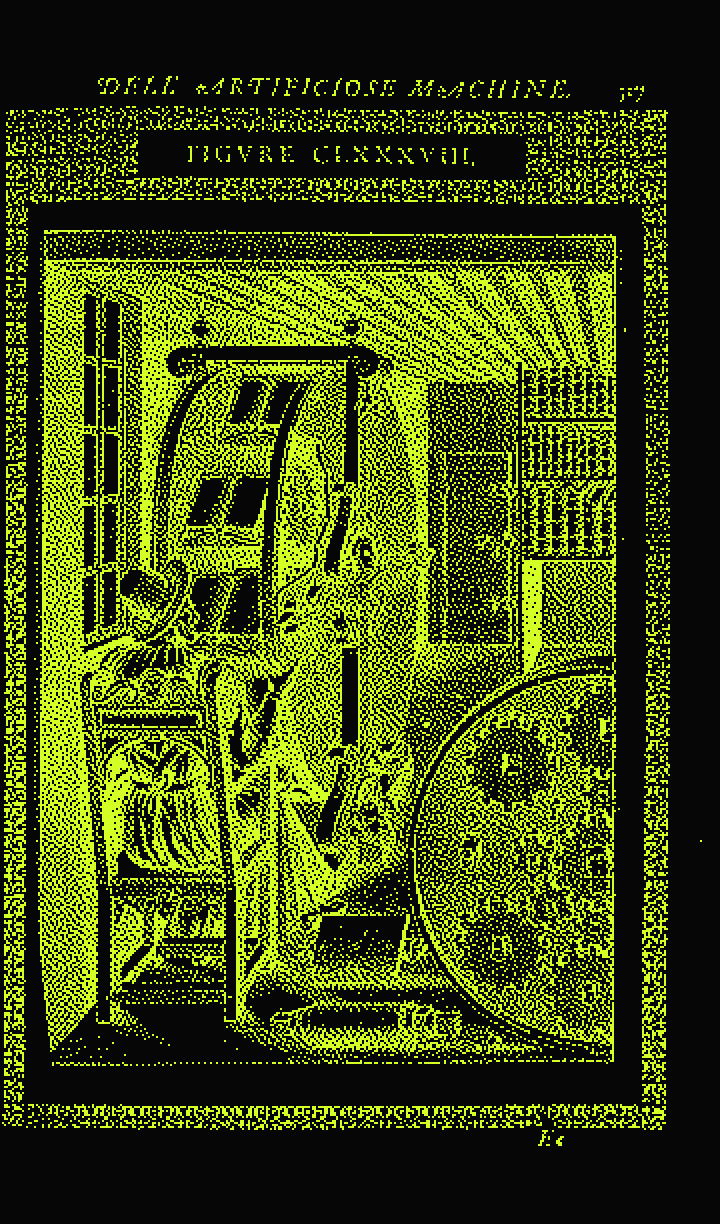
Too many books, too small a desk: it is an old problem for scholars. In 1588 the Italian engineer Agostino Ramelli drew a “book wheel” in his Le diverse et artificiose machine (The Various and Ingenious Machines). The reader sat in front of it and turned the wheel to move back and forth between stacks of open books, without getting up and without taking over a large table.2
In July 1945 The Atlantic Monthly published Vannevar Bush’s “As We May Think”. An editor’s note explained that, as Director of the Office of Scientific Research and Development, the author had coordinated some six thousand leading American scientists in the application of science to warfare.3 With the war nearly over, Bush was thinking about what scientists should do next. Human experience, he complained, was accumulating at a prodigious rate, yet our ways of threading through the maze to whatever matters at the moment were no better than in “the days of square-rigged ships”. Mendel’s laws of genetics had lain forgotten for a generation, simply because his paper never reached the handful of people who could understand it and take it further.
He imagined a desk called the memex, which would store a person’s books, records and correspondence and call them up at great speed. But what mattered most to him was “tying two items together”. The human mind, he argued, does not work through alphabetical order and classification; it works by association. The owner of a memex could build a trail of his own interests through the maze of material, insert comments, branch off along side trails to other items, and even copy the whole trail and pass it to a friend. Bush predicted new kinds of encyclopedia, with webs of associative trails already woven through them, and a new profession of “trail blazers”: people who would take delight in cutting useful paths through the vast common record of humanity.3
The essay found its readers. In the autumn of 1945 Douglas Engelbart, then on the island of Leyte in the Philippines, read it in a Red Cross library on the edge of the jungle.4 On 9 December 1968, at the Fall Joint Computer Conference in San Francisco, he connected to the NLS system at the Stanford Research Institute, some 30 miles away, and gave a ninety-minute live demonstration – the mouse, hypertext links, windows, shared-screen collaboration, video conferencing – that came to be known as “the Mother of All Demos”.5 Somewhat earlier, Ted Nelson had used the word “hypertext” in public at the 1965 national conference of the Association for Computing Machinery;6 his Xanadu project, founded in 1960, pursued two-way links that would never break, “transclusion” (quoting without copying) and complete version management.78
Yet it was a physics laboratory that brought hypertext into every home. In March 1989, at the European Organization for Nuclear Research (CERN), Tim Berners-Lee wrote “Information Management: A Proposal”. Staff there typically stayed only two years, he pointed out, so information was constantly being lost; often it had been recorded and simply could not be found. And CERN, he added, was “a model in miniature” of what the rest of the world would be a few years later.9 In August 1991 he announced the World Wide Web software on Internet newsgroups; that December the first web server in the United States went online at the Stanford Linear Accelerator Center (SLAC), to make it easier to search SPIRES, the database of high-energy physics preprints kept by the centre’s library.1011 CERN’s official short history says that the Web “was originally conceived and developed to meet the demand for automated information-sharing between scientists in universities and institutes around the world”.10
Then, in 1995, Ward Cunningham opened the first wiki;12 Wikipedia went online in January 2001 and turned twenty-five in 2026.13 Anyone can leave a trail; encyclopedias come with a web of associations woven in; Bush’s vision has become part of everyday life. In hindsight, hypertext was made for researchers from the start: Bush was writing for post-war scientists, Berners-Lee for his colleagues at CERN, and the first website in the United States served physics preprints. It changed almost everything – but barely touched the paper.
3Why didn’t hypertext change the paper?#
Today’s papers are all online, of course. But click on one and what opens is most likely a PDF: columns, page numbers, numbered figures and tables, everything laid out as if on paper. In 1999 Nelson jeered that imitating paper on a computer screen is like “tearing the wings off a 747 and using it as a bus on the highway”.14 The FORCE11 manifesto, published after the “Beyond the PDF” workshop of 2011, complained in the same vein that scholars still communicate their research mainly through “the selective distribution of ink on paper”, or at best through electronic facsimiles of it.15 How digitization merely swapped the paper for a screen is told elsewhere; here the only question is why a technology invented for scientists did not change the way scientists write.
The most fundamental reason is credit. Academic credit is tied to static units that can be cited and counted. A paper has fixed authors, a title, a journal, a volume, an issue and page numbers, and it does not change after publication; only so can it be cited precisely, listed on a CV and put before assessors. The strength of hypertext is precisely its fluidity: it can be revised at any time, and its edges are blurred. How many papers is an ever-growing web page worth? When you cite it, which version are you citing? Ever since Philosophical Transactions was founded in 1665, the scholarly community has built its judgements, its rewards and its memory on the article as the unit: peer review, evaluation, even retraction all proceed article by article. A medium has never been merely a container; it defines what counts as a result, which is exactly how media shape knowledge. Hypertext supplied no new unit, so it could only be absorbed by the old one, and it became a pipeline for delivering PDFs. None of this is surprising. People habitually measure a new technology with concepts formed around the old: the car was seen as a self-propelled carriage, the telegraph as a faster letter, the printed book as a more efficient manuscript, the web page as a superior book page. As long as the whole environment has not been rearranged around the new medium – as long as evaluation, reward and memory are still counted in articles – the car remains a carriage without a horse, and hypertext remains a faster postal route.16
The second reason is that links themselves are unreliable. In 2014 Jonathan Zittrain, Lawrence Lessig and a colleague found that more than seven in ten of the URLs in three Harvard law journals no longer pointed to the content originally cited, and that the same was true of about half the URLs in the opinions of the US Supreme Court.17 The same year, Martin Klein, Herbert Van de Sompel and colleagues analysed more than 3.5 million articles in science, technology and medicine published between 1997 and 2012, and found that one in five suffered from “reference rot”: the links were dead or the content had changed, so that readers could no longer get back to the web context in which the article was written. Among articles that cite web resources the proportion was seven in ten – and such articles are becoming ever more common.18 A 2024 study by the Pew Research Center found that 38% of web pages that existed in 2013 were no longer accessible by 2023, and that 54% of Wikipedia pages had at least one dead link among their references.19 In 2024 Martin Paul Eve checked more than seven million journal articles with DOIs and found that about 28% had no copy at all in the major long-term preservation archives.20
The third reason is versions. Once printed, a paper copy never changes; anything online can be altered at any moment, and the sentence you cited may be gone tomorrow. HTML, Nelson said, was “precisely what we were trying to PREVENT” with Xanadu: links that keep breaking, links that point only outward, quotations that cannot be traced back to their source, no version management.14 Publishing’s answer was to freeze the flow again: a 2008 industry recommendation divided the life of a journal article into seven stages, among them the Author’s Original, the Accepted Manuscript and the “Version of Record”.21 Academia accepted the web – but accepted it as a courier service for paper. There is one more reason, and it lies in the direction the web itself has taken. The early World Wide Web was built out of personal home pages and blogs; it was decentralized by nature, and elite knowledge had room to settle. Web 2.0 brought industrial production and the logic of traffic into the web, and all information came to flow across a single flat plane. The two strata that had coexisted since the advent of printing – fast-perishing mass culture and slowly settling elite knowledge – were pulled level. The Chinese-language internet went to an even greater extreme: personal websites have all but disappeared, everything has to follow the logic of the big social platforms, and the space in which elite information could settle has been wiped out. Scholars’ home pages and blogs were the closest thing to Bush’s “trails”; their decline has left the paper with even fewer rivals. If hypertext is truly to change scholarly works, the questions of credit, units, versions and archiving have to be answered together – and the space for knowledge to settle has to be rebuilt.
4How many layers can a work have?#
The first step towards an answer is to unpack “a paper” into “a work”. The manifesto argues that a single piece of research should have seven layers at once: a core argument compatible with journals; traceable evidence, with the data, code and lab records a click away; a process record that keeps failed paths and differences between versions; multimodal explanation, made up of videos, interactive models and concept maps; governance transparency, disclosing ethics, funding and the use of AI; an AI interface for machines to read; and collaborative evolution, open to criticism, replication and forking. The seven layers offer different entrances. The public comes in through the videos, beginners through the concept maps, peers through the paper, replicators through the data, overseers through the funding and ethics records, and machines through the interface.
This is not an idea conjured out of thin air. In 2009 a volume from the European DRIVER II project proposed “enhanced publications”: publications and related objects had always been processed separately, the connections between them were hard to find, and publications themselves should provide those links.22 The FORCE11 manifesto of 2011 called for rethinking the paper as the standard “unit of currency” in which knowledge is exchanged, and proposed the “research object”: a container holding a paper together with its associated datasets, workflows and software.15 In 2013 Sean Bechhofer and colleagues argued for treating research objects as “first class citizens” of sharing and publishing;23 the FAIR principles of 2016 require research data to be findable, accessible, interoperable and reusable, and state that the principles also apply to the algorithms, tools and workflows that produce the data.24 All of these belong to the open-science toolbox.
What is new about the seven layers is not any single layer but treating them all as facets of the same work rather than as appendages to a paper. Under the old regime, data are “supplementary material”, code is “available on request”, explanation counts as “popularization”, and failed attempts are simply never written up; in terms of credit, all of them rank below the paper. Writing on the basis of his lecture at the 2026 International Congress of Mathematicians, Terence Tao observes that authors can genuinely help the community digest a result by describing “the insights, the false starts, and the stories” from the time they were working on the problem.25 That is exactly what the process-record layer is meant to preserve.
The explanation layer needs legitimizing too. In an appendix to the same essay, Tao lists several new kinds of infrastructure, among them Mathematical Discourse, a peer-reviewed mathematics journal devoted to videos of research talks.25 Exposition, too, can be refereed, cited and counted as an achievement. The seven layers do not ask for everything to be flattened; they ask for each layer to have its proper place, with its own readers, its own quality standards and its own credits – who shot the explanatory video, who prepared the data, who replicated the result, all stated openly. A work then stops being a photograph and becomes something more like a house with several entrances.
5How can every entrance be a starting point?#
The second step is to link single works into a web. “Fractal” is a term from geometry: the part resembles the whole, so that if you zoom in on a stretch of coastline, what you see is still a ragged coastline. The manifesto is one starting point. Each of its screens leaves a few follow-up questions, and clicking one takes you to the topic page of one of the further topics. A topic page is another starting point: you can read it through and leave, or dive down into the deep read. The claims in a deep read link in turn to sources, evidence and process, and also pull in other topics. Every layer has a complete beginning, argument and conclusion, and every layer points to a deeper one. At every scale the reader meets the same structure – a starting point and a few paths – and any node in the network may become another reader’s starting point. I have used the word “fractal” before, in outlining a general history of technology: large and small environments show a self-similar structure, and technological environments at different scales tend to be structured alike.26 But layering is not flattening, and neither is decentralization; its virtue is precisely that it allows richer layers to form from the bottom up. That is why I have argued that we need city walls, but also gates, and thresholds at the gates.27 The topic page is the gate, the deep read is the threshold, and the sources, data and process are the streets and alleys within the walls. The further in you go, the more is asked of you.
Layered reading is nothing new. The newspaper’s inverted pyramid puts the most important facts in the opening paragraph; Nelson imagined “stretchtext”, in which the text unfolds further detail on the spot whenever readers want to know more.28 Today’s web pages can do this effortlessly. The hard part is the writing: the same argument has to be written at several scales, without distortion at any of them. A topic page is not a table of contents, nor an expanded abstract, but a short piece that stands on its own and is enjoyable to read. Nor is a deep read a padded-out topic page; it puts back the evidence, qualifications and counter-examples that were compressed away. The meaning of a work lies precisely in what cannot be compressed: a topic page can save readers time, but it cannot save them that.29 How links are written matters too. A “see Section X” link reflects table-of-contents thinking; we prefer to use questions as the thread. A screen ends by leaving a follow-up question, and whoever wants to keep asking is taken to the place that answers it. A question is more honest than a keyword: it tells readers why they should take the next step.
A fractal structure also means that the unit of curation changes from the single article to a set. A question network consists of several interlinked topics, each with its own question, which together answer a larger one. It resembles a special issue of a journal, except that the articles in a special issue rarely talk to one another; it resembles Wikipedia, except that Wikipedia aims at neutral summary, whereas a question network lets its authors take positions and sign their names. Each concept is explained thoroughly in one place only, and elsewhere a question points to it; revise it in one place, and the revision is visible everywhere. The network also grows: new works join, old nodes are criticized and replaced, and its boundaries shift as research advances. What deserves evaluation, then, is not only whether a single article is well written, but whether a set of works has got to the bottom of a question. Perhaps this is what the next body looks like.
It also requires taking readers’ paths seriously. For Bush, the most precious thing was not the documents themselves but the trails left through them. What a master leaves his disciples, he wrote, is not only his additions to the world’s record but also “the entire scaffolding by which they were erected”.3 Within the same network, a beginner may walk from an explanation to a definition, a peer may go straight from a claim to the data, and a critic may hunt for counter-examples and records of failure; every path is an interpretation of the set of works. The paths can themselves be curated: a teacher can lay out a guided route for beginners, a critic can leave a route that does nothing but pick holes. A good platform should let readers save and share their own paths, so that “how to read” also becomes knowledge that can be exchanged.
6Has anyone done this already?#
This form already has plenty of precedents. In March 2011 Bret Victor published “Explorable Explanations”, proposing the “reactive document”, in which readers can play with the author’s assumptions and immediately see the consequences. He wanted text to stop being merely “information to be consumed” and to become “an environment to think in”.30 From September 2016 a group of machine-learning researchers published interactive articles in Distill, which formally launched as a journal in March 2017.3132 In “Research Debt”, its two editors, Chris Olah and Shan Carter, argued that the “research distiller”, who makes research clear, should be regarded, like the theoretician and the experimentalist, as indispensable to the research community – yet such work is still not treated as a genuine research contribution.33 Then, in July 2021, Distill announced a hiatus. For some of its early articles, the editors had spent more than fifty hours on the diagrams and the prose, all of it volunteer work on top of their regular jobs; most types of article, they concluded, would probably be self-published in future.34
A second strand is the “living” review. In 1998 the Max Planck Institute for Gravitational Physics in Germany founded Living Reviews in Relativity, whose articles are regularly updated by their authors.35 Its founder, Bernard Schutz, said in 2013 that it could in some respects be called “the Wikipedia of science” – except that its authors are selected and its articles go through strict peer review, and the standards are higher, because the articles are meant to serve as authoritative works of reference.36 Minor revisions are made as quick annual updates and keep the original article number; major revisions go back through review and receive a new number; older versions can still be found in the article’s history.37 In 2014 medical researchers proposed “living systematic reviews”, updated continuously as new evidence emerges.38 Living reviews show that being updatable and being citable are not at odds, provided the versions are managed clearly.
A third strand is the executable paper. After LIGO’s first detection of gravitational waves, its Open Science Center offered a tutorial on analysing the GW150914 signal, in which readers could do the filtering and spectral analysis themselves in an IPython notebook.39 In 2018 James Somers published an article in The Atlantic under the title “The Scientific Paper Is Obsolete”, pinning his hopes on computational notebooks such as Mathematica and Jupyter.40 In August 2020 eLife launched “Executable Research Articles”, which let readers inspect, modify and re-run a paper’s code in their browser;41 the American Geophysical Union, with funding from the Sloan Foundation, started the “Notebooks Now!” project, which aims to make computational notebooks primary research objects in scholarly publishing.42
A fourth strand breaks the paper into finer pieces and then links them into a graph. In 2010 Paul Groth and colleagues proposed the “nanopublication”, which treats a single core scientific statement, together with its context, as a unit that can be discovered, linked and curated in its own right.43 OpenAlex, launched in January 2022 as the successor to the Microsoft Academic Graph, links 477 million works with their authors, institutions and funders in one open graph;1 the Open Research Knowledge Graph (ORKG), run by TIB, Germany’s national library of science and technology, attempts to describe the research contributions of papers in machine-readable form.44
Mathematics has gone furthest. In November 2023 Terence Tao and others formalized the proof of the polynomial Freiman–Ruzsa conjecture in Lean, using Blueprint, a tool developed by Patrick Massot, to link the human-readable proof to the code; on the dependency graph, green marks what has been fully formalized and blue what is ready to be formalized.45 In September 2024 Tao launched the Equational Theories Project, inviting anyone to contribute Lean proofs on GitHub.46 On 14 April 2025 the project determined all 22,028,942 implication relations among 4,694 equational laws for magmas, with both human-written and automated proofs checked by Lean.47 A result presented as a dependency network that anyone can click through and that can be checked at every point is, in a sense, also a new form of citizen science in mathematics. How mathematicians are responding to AI is discussed elsewhere; here I only want to point out that fractal curation already exists in embryo in mathematics.
7Should works be machine-friendly?#
The readers of a fractal network are not only human. In April 2025 the Wikimedia Foundation reported that at least 65% of its most resource-intensive traffic came from bots, even though bots accounted for only about 35% of pageviews.48 In October that year the foundation said that human pageviews of Wikipedia had fallen by about 8% on the previous year, partly because search engines now use generative AI to give answers directly.49 Cloudflare’s data show that in July 2025 Anthropic’s crawlers fetched some 38,000 pages for every single visit they sent back to websites.50 In research, an “AI scientist” called Kosmos reads about 1,500 papers on average in a single run.51 The most diligent reader of a piece of research may well already be a machine.
Being machine-friendly starts with saying clearly what a thing is. In June 2011 Google, Bing and Yahoo jointly launched the schema.org vocabulary, which lets a web page use shared structured data to declare whether it is a scholarly article, a dataset or a person; the data can be written into the page as JSON-LD.52 Google Scholar, likewise, asks for meta tags such as `citation_title` stating the title, authors and date, and for each article to have a page of its own.53 Such rules look trivial, but they decide whether a work can be found, recognized and correctly cited by machines.
Machines also need a clean text. In September 2024 Jeremy Howard proposed placing a Markdown file called llms.txt in a website’s root directory and offering Markdown versions of its pages.54 Whether this helps is still disputed: in 2025 Google’s John Mueller said that, as far as he knew, none of the AI services had said they were using it;55 Common Crawl’s July 2026 crawl turned up about 580,000 llms.txt files, only about half of them with a complete structure.56 RenaSci does all of these things: its work pages embed schema.org data, adding `?format=md` to a work’s address returns Markdown, there is an llms.txt in the root directory, the works library has an open REST API, and a CC BY 4.0 licence is declared.57
More important still is helping machines tell claims, evidence and speculation apart. In a paper, “we prove”, “the data show” and “we conjecture” are all set in the same typeface. Human readers tell them apart by experience; machines easily mistake a conjecture for a conclusion. Nanopublications represent a statement and its context separately;43 the dependency graphs of formalized mathematics mark what has been proved and what remains to be proved in different colours.45 Kosmos cites code or primary literature for every statement in its reports, so each statement can be traced and therefore checked: independent scientists found 79.4% of them to be accurate.51 A layered work should offer a structured list of its claims, each linked to the data, code and passages that support it; attach executable code and open interfaces, and machines can not only read but also recompute. This is not pandering to machines. It forces authors to make the structure of their argument clear, which benefits human readers just as much.
8As links multiply, who vouches for them?#
The more links there are, the more trust becomes a problem. In the history of science, credibility has never come built into a text. Studying Robert Boyle’s air-pump experiments, Steven Shapin and Simon Schaffer showed that experimental facts were produced jointly by three technologies – material, literary and social – and that detailed experimental reports allowed readers who had not been present to take part in “virtual witnessing”.58 The paper is a descendant of this technology of witnessing. On the web, the technology of witnessing needs a new generation, and the manifesto has set out new standards for it: evidence you can click open, results someone can explain, AI in plain sight. In technical terms that means at least four things: identifiers and archiving, citations precise to the paragraph and the version, change logs, and automatic records of AI’s involvement.
A DOI gives a work a name that does not change when its web address does. But a name is not a copy: as noted above, about 28% of articles with DOIs have no copy in the major archives.20 Zenodo, launched by CERN and OpenAIRE in 2013, accepts research outputs in any form and distinguishes between a DOI that stands for all versions of a work and a DOI for one particular version;5960 the Leiden Declaration of June 2026 is archived there.61 Software Heritage, initiated by Inria, the French national institute for research in computer science and automation, in partnership with UNESCO, has made it its mission to preserve all publicly available source code;62 by the end of September 2026 it had archived about 30 billion source files.63 The Internet Archive’s Wayback Machine passed one trillion archived web pages in October 2025.64 Against link rot, Herbert Van de Sompel and colleagues proposed the Memento protocol, which can retrieve earlier states of a web page by date;65 Robust Links recommends that every link record the original URL, an archived snapshot and the date of linking.66
For the granularity of citation, mathematics already offers a model. The Stacks project, an ever-growing open-source reference work on algebraic stacks – conceived in 2005, begun in 2008 and maintained by Johan de Jong – now has more than 21,000 “tags”. Each result has a permanent four-character tag that points to it whichever chapter it is moved to; and if a result turns out to be wrong and is removed, its tag is kept, together with an explanation of why it disappeared.676869 Since 2013 the website has also been able to draw a dependency graph for every result.70 Software Heritage identifiers can point to particular lines of a particular source file.71 A question network should do the same: every paragraph should have a stable anchor and every version a frozen snapshot, so that a link a reader clicks today will still land on the same sentence ten years from now. The point of citation has never been decoration. It is to make it easy for peers to check and criticize, and to mark one’s own position in the public space of scholarship. Nor has credibility ever come from any single sentence; it comes from an array of texts, layer upon layer. The more texts one draws on, and the thicker they are, the more reliable the conclusion: certainty is a stable node in a web of relations.72 Anchors and snapshots simply make it possible to follow this web step by step in the age of the internet too.
Changes and disclosures, too, must leave traces. The update rules of living reviews already show that revision and citation can coexist.37 In January 2023 Nature ruled that large language models cannot be listed as authors and that researchers who use them should say so in the methods or acknowledgements;73 the Leiden Declaration likewise requires disclosure of the tools used and reserves authorship for humans;61 for practice across the disciplines, see the rules of journals, funders and learned societies. At the end of the essay based on his congress lecture, Tao states that AI was used for literature search, for generating diagrams, for autocompleting text and for converting the slides into a paper.25 But disclosure should not be a statement added after the fact, like a confession; it should be an automatic by-product of the process. Which model was used, which sources were consulted, which paragraph was changed – all this is already recorded in the course of the research, and the platform need only display it. The more deeply AI takes part in searching, writing and computing, the more this record becomes part of what makes a work credible.
The strongest form of witnessing is formal verification. In December 2020 Peter Scholze publicly asked for one of his theorems to be verified in Lean. He had been obsessed with the proof for most of 2019, yet he felt that no one else had dared to examine it closely; he still had “some small lingering doubts”, and he admitted that he had occasionally managed to convince people with wrong arguments.74 A year and a half later, the “Liquid Tensor Experiment” completed the verification.75 Tao writes that the correctness of a formally verified proof no longer depends on the reputation or the diligence of its author; but “a proof that no human can properly explain should be viewed as incomplete, even if it has been formally verified”.25 Machines can witness that a proof is right; they cannot yet witness that it is understood.
9Does mapping knowledge count as scholarship?#
Arranging a network like this calls for a new scholarly role: the curator. The English word “curator” comes from the Latin curare, “to take care of”; only in the 1660s did it come to mean someone in charge of a museum.76 A museum curator picks a few dozen objects out of tens of thousands, arranges them along a route for visitors, writes labels for the exhibits and an introduction to the exhibition, and once the show is over restores, catalogues and looks after them. A scholarly curator does almost exactly the same: chooses which works enter the network, decides on the starting point and the paths, writes a topic page and follow-up questions for each topic, and in the years that follow revises, repairs dead links and answers critics.
This role was foreseen long ago: Bush’s “trail blazers”,3 Olah and Carter’s “research distillers”. The latter two add that refining and explaining ideas “requires creativity and deep understanding, just as much as novel research”.33 Scholarship has always depended on work of this kind: review articles, textbooks, guest editors of special issues, the people who look after subject areas on Wikipedia – all of them select, arrange, explain and maintain. In 2015 Timothy Gowers announced the founding of Discrete Analysis: the papers stay on arXiv, while the journal organizes peer review and gives each accepted paper an introduction written by an editor and a DOI.77 Such an “overlay journal” is itself a layer of curation. The curator is also one of the new positions that open up once the roles are split apart.
The trouble is that such work rarely earns credit. A review may be heavily cited and still, in many evaluation systems, count for less than an “original” paper; maintaining a database, a tagging system or a dependency graph is even harder to put on a CV. Fortunately, things are beginning to loosen. CRediT, the Contributor Roles Taxonomy, which became an American national standard in 2022, lists 14 roles, among them “Data curation” and “Visualization”.78 One of the manifesto’s fourteen theses says that reputation is achievement, not a count. Curation ought to be one such achievement: how many people have made their way through the network you arranged, how many beginners your guide has helped to find their feet, how many years the nodes you maintain have gone without a dead link.
AI will make curation cheap, and it may also make it dangerous. AI can survey every book there is, reading more, and faster, than any person; it can write reviews, draw dependency graphs and check for dead links, and its drafts of topic pages may be no worse than a human’s. But the responsibility for choosing the books still lies with people.79 Curation is, in the end, a matter of selection and connoisseurship, and the scholar’s position is more like that of a wine taster: laboratory analysis can reveal a wine’s composition more precisely, but it cannot replace the taster, because only people love wine. Machines are in charge of intelligence; humans are in charge of love.80 What enters the network and what is left out, which path is set as the starting point, which counter-example must be displayed prominently: these judgements decide the landscape of knowledge that readers will see. If selection, too, is handed to algorithms optimized for click-through, curation will degenerate into recommendation, and the network will look more and more like a mirror that reflects nothing but its readers’ preferences. Selection and judgement belong to people, and people who sign their names should answer for them.
10Will readers get lost in the network?#
Fractal curation carries real risks. The first is the labyrinth. Links give readers freedom, and also the chance to get lost: after five or six clicks, readers often forget why they set out and have no idea how much remains unread. The second is fragmentation. Once an argument is broken into nodes, each node can be shared on its own – and so quoted out of context; nanopublications and knowledge graphs make statements easier for machines to handle, but also make it easier for those statements to come loose from their qualifications and counter-examples. The linear narrative of the paper has its reasons: it forces the author to put premises, reasoning and conclusions on a single road, and it forces the reader to walk that road to the end. But I have no intention of singing a dirge for the print era. Compare short video with the printed book: the narrative forms of the network age are bound to be more fragmented and more emotional. That is the tide of the times. The task is not to drive readers back to long linear texts but to rebuild layers among the fragments.
The third is attention. In 1971 Herbert Simon observed that information “consumes the attention of its recipients”, so that “a wealth of information creates a poverty of attention”.81 Multimodal works that can be clicked open layer after layer all compete for the same attention. Once a platform ranks things by clicks and time on page, curation will sink into a contest of headlines and short videos, replaying the old malady of the rule of metrics in a new form. There is a limit to how fast human attention can “refresh”, but none to how fast production can accelerate, and refreshing too fast crowds out precisely immersion, rumination and savouring.82 Yet immersion and drifting are two tendencies, and people need both; the difference between the otaku and the smartphone zombie lies not in content but in form.83 A good network must let people wander between nodes, and also have rooms where they will stop and stay. Tao warns, too, that exposition can be over-optimized: a proof polished too smoothly by AI may “sand away” the friction that the author left at the hard places, “leaving a text that is easy to read and hard to learn from”.25 Topic pages must be especially wary of this. AI readers bring risks of their own: an AI may draw conclusions after reading only the topic page, mistaking a single node for the whole network.
The fourth is rot and maintenance. Executable papers rot as well: a 2019 study gathered 1.4 million Jupyter notebooks from GitHub, and of the more than 860,000 it attempted to run, only 24.11% ran without errors and only 4.03% reproduced their original results.84 The hiatus at Distill shows that carefully crafted works need sustained human effort.34 As early as 1999 Nelson described the web as “a foam of ever-popping bubbles, ever-changing shopwindows”.14 The fifth is being “forever unfinished”: a work that can be revised at any time can also never be finalized. Xanadu, begun in 1960, was already described by Wired in 1995 as “the longest-running vaporware story in the history of the computer industry”.8
Most of the remedies involve carrying the useful disciplines of the old system over into the network. There must be a clear starting point: every question network has an entry page that says what question it answers and where to begin reading. There must be layers: each topic first offers a topic page that can be read on its own, giving the complete argument without a single click. There must be a map, showing all the nodes and the main paths and marking where the reader is at the moment. Versions must be frozen: numbered versions are released and archived at regular intervals, and citations point to the frozen versions. And there must be a commitment to maintenance: who is responsible, for how long, and how the work will be archived when maintenance stops. Being unfinished can be a kind of honesty, but every stage should have a finished version that can be cited and criticized.
11Does this network practise what it preaches?#
By now readers may have noticed that this essay is itself part of what it describes. This set of topics has eight nodes. The starting point is the manifesto, The Renaissance of Science: science keeps progressing, and what needs reviving is not the knowledge of the ancients but the joy of inquiry – for which knowledge needs a new body. The seven further topics each pursue one direction. The Body of Knowledge asks whether the paper is the only body knowledge can have; Flood and Dykes asks why papers are becoming ever more numerous and ever harder to read; Science’s Audience asks why the public should come back to science; For Curiosity asks whether research can still be fun; AI Enters the Lab asks where the real bottleneck lies now that AI has entered every discipline; The Academic Assembly Line asks where the passion for knowledge went once research became a job; and this essay asks what a scholarly work should look like if it is no longer a paper.
Each node has two layers, plus a layer of sources: a topic page that can be read through by scrolling, an annotated deep read, and the references behind the deep read. Every screen of a topic page opens with a question and ends with a few follow-up questions; click one, and you walk into the topic that answers it. The follow-up questions on each screen of the manifesto lead to the further topics, and every further topic has follow-up questions leading back to the manifesto. The deep reads link to one another at specific points in their arguments, and on the web page the footnotes turn into links to the sources. Readers can start from any question, and wherever they arrive becomes a new starting point.
The map also marks out a few question routes, which readers can follow or ignore. Readers who care about what is to be revived can set out from the manifesto’s screen on the joy of inquiry, walk on to wonder and leisure and then to books, and see how printing kept that earlier renaissance from ever fading. Readers who want to know what alienated science can go from the assembly line to the rule of metrics and on to the joy that got squeezed out. Those who wonder how a crisis becomes a turning point can go from the shifting bottleneck to the revival of citizen science. And readers who just want to know what comes next can turn straight to the section of the manifesto on what we are going to do. Each route is one way of reading, and also one interpretation.
It will also keep being revised. The manifesto has already gone from v0.1 to v0.6, and this question-network edition (v0.8) rewrote it entirely around “the renaissance of science”; every version states who set the direction and what AI contributed. This set of topics will follow the same practice – frozen versions, public changes. AI has been involved in drafting it as well, and the version record will make clear who did what. To be specific, my recent process for writing books goes like this: I have one AI produce a first draft; I revise one chapter myself to show the direction I want; I have another AI revise and expand the rest on that basis; then I add and revise again myself; and finally I hand the text to an AI for proofreading and polishing.85 I have also tried another kind of collaboration: having an AI play a journalist and interview me, then excerpt, polish and publish the result as a journalist would. I call this “AI-reporter style”, because having an AI write directly in my name always feels wrong – I do, after all, take pleasure in the writing itself. This set of topics naturally carries all the risks listed in the previous section, and it has not escaped the old standards described earlier either: these deep reads are still divided into sections, footnoted and finalized, still hold themselves to the print era’s standards for what an “article” is, and in the end are still measured from the standpoint of the printed book.72 Building it is precisely a way to test those risks in front of real readers. Whether a question network works depends not on how dense its links are, but on whether readers who have followed the questions along one path to its end understand more than they would have from reading a paper.
※Sources
- 1
OurResearch, “About us”, OpenAlex Help Center, accessed 30 September 2026 (indexes more than 477 million scholarly works; beta launched 3 January 2022; successor to the Microsoft Academic Graph; data released under CC0). help.openalex.org/hc/en-us/articles/24396686889751-About-us ↩↩2
- 2
Agostino Ramelli, Le diverse et artificiose machine del capitano Agostino Ramelli (Paris, 1588), plate 188 (the book wheel). Science History Institute Digital Collections. digital.sciencehistory.org/works/w6634396g ↩
- 3
Vannevar Bush, “As We May Think”, The Atlantic Monthly, July 1945. theatlantic.com/magazine/archive/1945/07/as-we-may-think/303881/ Full text archived by the W3C: w3.org/History/1945/vbush/vbush-all.shtml ↩↩2↩3↩4
- 4
Douglas C. Engelbart, letter to Vannevar Bush, 24 May 1962 (transcribed in Stanford University course materials). web.stanford.edu/class/history34q/readings/Engelbart/Engelbar… ↩
- 5
Doug Engelbart Institute, page on the demonstration of 9 December 1968 (“The Mother of All Demos”), accessed 2026; for the features shown, see also Computer History Museum, “Douglas C. Engelbart – 2005 Fellow”, and SRI International, “1968 ‘Mother of All Demos’ Forecasted Much of the Technology We Use Every Day”, 10 December 2012. dougengelbart.org/content/view/209/ ; computerhistory.org/profile/doug-engelbart/ ; sri.com/press/blog-archive/1968-mother-of-all-demos-forecaste… ↩
- 6
T. H. Nelson, “Complex Information Processing: A File Structure for the Complex, the Changing and the Indeterminate”, Proceedings of the 1965 20th ACM National Conference (1965), pp. 84–100. doi.org/10.1145/800197.806036 ↩
- 7
Project Xanadu, official home page (“Founded 1960 · The Original Hypertext Project”), accessed 2026. xanadu.com/ ↩
- 8
Gary Wolf, “The Curse of Xanadu”, Wired 3.06, June 1995. wired.com/1995/06/xanadu/ ↩↩2
- 9
Tim Berners-Lee, “Information Management: A Proposal”, CERN, March 1989 (recirculated May 1990). w3.org/History/1989/proposal.html ↩
- 10
CERN, “A short history of the Web”, accessed 2026. home.cern/science/computing/birth-web/short-history-web ↩↩2
- 11
SLAC Archives, History & Records Office, “WWW@SLAC Exhibit”, accessed 2026 (online from 12 December 1991, serving the SPIRES-HEP preprint database). ahro.slac.stanford.edu/wwwslac-exhibit ↩
- 12
Wikipedia, “WikiWikiWeb” (used as a last resort; the article dates its launch by Ward Cunningham to 25 March 1995, as a companion to the Portland Pattern Repository), accessed 2026. en.wikipedia.org/wiki/WikiWikiWeb ↩
- 13
The Signpost, “News and notes”, 15 January 2026 (“January 15, 2026, marks the 25th anniversary of the 2001 inception of Wikipedia”). signpost.news/2026-01-15/News_and_notes ↩
- 14
Ted Nelson, “Ted’s ComParadigm in OneLiners”, 29 January 1999. xanadu.com.au/ted/TN/WRITINGS/TCOMPARADIGM/tedCompOneLiners.html ↩↩2↩3
- 15
FORCE11, “FORCE11 Manifesto: Improving Future Research Communication and e-Scholarship”, 28 October 2011. force11.org/info/force11-manifesto/ ↩↩2
- 16
Hu Yilin 胡翌霖, 《科学文化史话》 [Talks on the cultural history of science] (Peking University Press 北京大学出版社, 2014). ↩
- 17
Jonathan Zittrain, Kendra Albert & Lawrence Lessig, “Perma: Scoping and Addressing the Problem of Link and Reference Rot in Legal Citations”, Harvard Law Review Forum 127 (2014): 176. harvardlawreview.org/forum/vol-127/perma-scoping-and-addressi… ↩
- 18
Martin Klein, Herbert Van de Sompel, Robert Sanderson et al., “Scholarly Context Not Found: One in Five Articles Suffers from Reference Rot”, PLOS ONE 9, no. 12 (2014): e115253. doi.org/10.1371/journal.pone.0115253 ↩
- 19
Athena Chapekis, Samuel Bestvater, Emma Remy & Gonzalo Rivero, “When Online Content Disappears”, Pew Research Center, 17 May 2024. pewresearch.org/data-labs/2024/05/17/when-online-content-disa… ↩
- 20
Martin Paul Eve, “Digital Scholarly Journals Are Poorly Preserved: A Study of 7 Million Articles”, Journal of Librarianship and Scholarly Communication (2024); figures from the author’s summary on the LSE Impact Blog (13 February 2024). blogs.lse.ac.uk/impactofsocialsciences/2024/02/13/the-digital… ↩↩2
- 21
NISO/ALPSP JAV Technical Working Group, “Journal Article Versions (JAV)”, NISO RP-8-2008, 2008. niso.org/publications/niso-rp-8-2008-jav ↩
- 22
Marjan Vernooy-Gerritsen (ed.), Enhanced Publications: Linking Publications and Research Data in Digital Repositories (Amsterdam University Press, 2009). library.oapen.org/handle/20.500.12657/99940 ↩
- 23
Sean Bechhofer et al., “Why linked data is not enough for scientists”, Future Generation Computer Systems 29, no. 2 (2013): 599–611. doi.org/10.1016/j.future.2011.08.004 ↩
- 24
Mark D. Wilkinson et al., “The FAIR Guiding Principles for scientific data management and stewardship”, Scientific Data 3 (2016): 160018. nature.com/articles/sdata201618 ↩
- 25
Terence Tao, “Mathematics in the age of AI”, arXiv:2608.16753, 2026 (based on a public lecture at the International Congress of Mathematicians, July 2026). arxiv.org/abs/2608.16753 ↩↩2↩3↩4↩5
- 26
Hu Yilin 胡翌霖, 《技术通史论纲》 [An outline of a general history of technology], Suixuan 随轩 (yilinhut.net), 21 November 2014. yilinhut.net/2014/11/21/5175.html ↩
- 27
Hu Yilin 胡翌霖, 《重建门槛——Web3确实是一种“圈地自high”的倒退,但未必是坏事》 [Rebuilding the threshold: Web3 really is a regression into “fencing off our own patch to have fun in”, but that is not necessarily a bad thing], Suixuan 随轩 (yilinhut.net), 30 January 2022. yilinhut.net/2022/01/30/8437.html ↩
- 28
Wikipedia, “Stretchtext” (used as a last resort; the article says the term was formally introduced by Ted Nelson in “No More Teacher’s Dirty Looks”, published in Computer Decisions in 1970), accessed 2026. en.wikipedia.org/wiki/Stretchtext ↩
- 29
Hu Yilin 胡翌霖, 《“刷”时代的我们还要“读”吗》 [In the age of “scrolling”, do we still need to “read”?], Suixuan 随轩 (yilinhut.net), 21 April 2023. yilinhut.net/2023/04/21/9193.html ↩
- 30
Bret Victor, “Explorable Explanations”, 10 March 2011. worrydream.com/ExplorableExplanations/ ↩
- 31
Distill, Archive (first article published 8 September 2016), accessed 2026. distill.pub/archive/ ↩
- 32
Shan Carter & Chris Olah, “Distill: Supporting Clarity in Machine Learning”, Google Research Blog, 20 March 2017. research.google/blog/distill-supporting-clarity-in-machine-le… ↩
- 33
Chris Olah & Shan Carter, “Research Debt”, Distill, 2017. distill.pub/2017/research-debt/ ↩↩2
- 34
Distill Editorial Team, “Distill Hiatus”, Distill, 2 July 2021. distill.pub/2021/distill-hiatus/ ↩↩2
- 35
Springer, Living Reviews in Relativity journal home page, accessed 2026. link.springer.com/journal/41114 ↩
- 36
Max-Planck-Gesellschaft, “In some respects, the Wikipedia of science” (interview with Bernard Schutz), 16 November 2013. mpg.de/7617181/in-some-respects-the-wikipedia-of-science ↩
- 37
Living Reviews in Relativity, “Update Guidelines” (EMIS mirror), accessed 2026. emis.univie.ac.at/journals/LRG/author-information/update-guid… ↩↩2
- 38
Julian H. Elliott et al., “Living Systematic Reviews: An Emerging Opportunity to Narrow the Evidence-Practice Gap”, PLOS Medicine 11, no. 2 (2014): e1001603. doi.org/10.1371/journal.pmed.1001603 ↩
- 39
Gravitational Wave Open Science Center (formerly the LIGO Open Science Center), GW150914 signal-processing tutorial (IPython notebook and Python script), last updated July 2017. gwosc.org/s/events/GW150914/GW150914_tutorial.html ↩
- 40
James Somers, “The Scientific Paper Is Obsolete: Here’s What’s Next”, The Atlantic, 5 April 2018. theatlantic.com/science/archive/2018/04/the-scientific-paper-… ↩
- 41
eLife, “eLife launches Executable Research Articles for publishing computationally reproducible results”, 24 August 2020. elifesciences.org/for-the-press/eb096af1/elife-launches-execu… ↩
- 42
Christopher Erdmann, Shelley Stall, Brooks Hanson et al., “Notebooks Now! Elevating Computational Notebooks”, Eos, 18 August 2022. eos.org/editors-vox/notebooks-now-elevating-computational-not… ↩
- 43
Paul Groth, Andrew Gibson & Jan Velterop, “The anatomy of a nanopublication”, Information Services & Use 30, no. 1–2 (2010): 51–56. doi.org/10.3233/ISU-2010-0613 ↩↩2
- 44
TIB – Leibniz Information Centre for Science and Technology, “About the ORKG”, Open Research Knowledge Graph, accessed 2026. orkg.org/about ↩
- 45
Terence Tao, “Formalizing the proof of PFR in Lean4 using Blueprint: a short tour”, What’s new (blog), 18 November 2023. terrytao.wordpress.com/2023/11/18/formalizing-the-proof-of-pf… ↩↩2
- 46
Terence Tao, “A pilot project in universal algebra to explore new ways to collaborate and use machine assistance?”, What’s new (blog), 25 September 2024. terrytao.wordpress.com/2024/09/25/a-pilot-project-in-universa… ↩
- 47
Matthew Bolan, Joachim Breitner, Jose Brox et al. (including Terence Tao), “The Equational Theories Project: Advancing Collaborative Mathematical Research at Scale”, arXiv:2512.07087, 2025. arxiv.org/abs/2512.07087 ↩
- 48
Wikimedia Foundation, “How crawlers impact the operations of the Wikimedia projects”, Diff, 1 April 2025. diff.wikimedia.org/2025/04/01/how-crawlers-impact-the-operati… ↩
- 49
Anthony Ha, “Wikipedia says traffic is falling due to AI search summaries and social video”, TechCrunch, 18 October 2025. techcrunch.com/2025/10/18/wikipedia-says-traffic-is-falling-d… ↩
- 50
João Tomé, “The crawl-to-click gap: Cloudflare data on AI bots, training, and referrals”, Cloudflare Blog, 29 August 2025. blog.cloudflare.com/crawlers-click-ai-bots-training/ ↩
- 51
Ludovico Mitchener et al., “Kosmos: An AI Scientist for Autonomous Discovery”, arXiv:2511.02824, 2025. arxiv.org/abs/2511.02824 ↩↩2
- 52
Google Search Central Blog, “Introducing schema.org: Search engines come together for a richer web”, 2 June 2011. developers.google.com/search/blog/2011/06/introducing-schemao… ↩
- 53
Google Scholar, “Inclusion Guidelines for Webmasters”, accessed 2026. scholar.google.com/intl/en/scholar/inclusion.html ↩
- 54
Jeremy Howard, “The /llms.txt file”, llmstxt.org, proposed 3 September 2024. llmstxt.org/ ↩
- 55
Roger Montti, “Google Says LLMs.Txt Comparable To Keywords Meta Tag”, Search Engine Journal, 17 April 2025. searchenginejournal.com/google-says-llms-txt-comparable-to-ke… ↩
- 56
Malte Ostendorff, “A Content Analysis of llms.txt Files from the July 2026 Crawl Archive”, Common Crawl Blog, 31 August 2026. commoncrawl.org/blog/a-content-analysis-of-llms-txt-files-fro… ↩
- 57
RenaSci, llms.txt (notes on machine access: schema.org ScholarlyArticle JSON-LD, ?format=md, REST API, CC BY 4.0), accessed 30 September 2026. renasci.xyz/llms.txt ↩
- 58
Steven Shapin & Simon Schaffer, Leviathan and the Air-Pump: Hobbes, Boyle, and the Experimental Life (Princeton University Press, 1985). press.princeton.edu/books/paperback/9780691178165/leviathan-a… ↩
- 59
Zenodo, “About Zenodo” (launched by CERN and OpenAIRE in May 2013), accessed 2026. about.zenodo.org/ ↩
- 60
Zenodo, “What is DOI versioning?”, Zenodo Help Center, accessed 2026. support.zenodo.org/help/en-gb/1-upload-deposit/97-what-is-doi… ↩
- 61
Leiden Declaration on Artificial Intelligence and Mathematics, 2 June 2026, doi:10.5281/zenodo.20302944. leidendeclaration.ai/ ↩↩2
- 62
Software Heritage, “Mission”, accessed 2026. softwareheritage.org/mission/ ↩
- 63
Software Heritage Archive, statistics counters API, read on 30 September 2026 (about 29.98 billion file contents, 6.17 billion commits and 445 million origins). archive.softwareheritage.org/api/1/stat/counters/ ↩
- 64
Internet Archive Blogs, “One Trillion Web Pages Archived: Internet Archive Celebrates a Civilization-Scale Milestone”, 31 October 2025. blog.archive.org/2025/10/31/one-trillion-web-pages-archived-i… ↩
- 65
Herbert Van de Sompel, Michael L. Nelson & Robert Sanderson, “HTTP Framework for Time-Based Access to Resource States — Memento”, RFC 7089, IETF, December 2013. rfc-editor.org/rfc/rfc7089 ↩
- 66
Robust Links, “About”, accessed 2026. robustlinks.mementoweb.org/about/ ↩
- 67
The Stacks project, “About” (idea conceived on 5 July 2005, first commit on 20 May 2008; maintained by Aise Johan de Jong), accessed 2026. stacks.math.columbia.edu/about ↩
- 68
The Stacks project, “Tags explained”, accessed 2026. stacks.math.columbia.edu/tags ↩
- 69
The Stacks project, “Statistics”, accessed 30 September 2026 (21,446 tags in total). stacks.math.columbia.edu/statistics ↩
- 70
Pieter Belmans, “A new website for the Stacks project: the sequel”, 30 July 2013. pbelmans.ncag.info/blog/2013/07/30/a-new-website-for-the-stac… ↩
- 71
SWHID Specification v1.0, “Qualified identifiers” (the lines qualifier), accessed 2026. swhid.org/specification/v1.0/6_Qualified_identifiers/ ↩
- 72
Hu Yilin 胡翌霖, 《媒介史强纲领:媒介环境学的哲学解读》 [A strong programme for media history: a philosophical reading of media ecology] (The Commercial Press 商务印书馆, 2019). ↩↩2
- 73
Editorial, “Tools such as ChatGPT threaten transparent science; here are our ground rules for their use”, Nature, 24 January 2023. nature.com/articles/d41586-023-00191-1 ↩
- 74
Peter Scholze, “Liquid tensor experiment”, Xena Project blog, 5 December 2020. xenaproject.wordpress.com/2020/12/05/liquid-tensor-experiment/ ↩
- 75
Mathlib community, “Completion of the Liquid Tensor Experiment”, Lean community blog, 15 July 2022. leanprover-community.github.io/blog/posts/lte-final/ ↩
- 76
Online Etymology Dictionary, “curator”, accessed 2026. etymonline.com/word/curator ↩
- 77
Timothy Gowers, “Discrete Analysis — an arXiv overlay journal”, Gowers’s Weblog, 10 September 2015. gowers.wordpress.com/2015/09/10/discrete-analysis-an-arxiv-ov… ↩
- 78
NISO, “ANSI/NISO Z39.104-2022, CRediT, Contributor Roles Taxonomy”, 2022. niso.org/publications/z39104-2022-credit ↩
- 79
Hu Yilin 胡翌霖, 《搜集世间一切书籍——AI时代的亚历山大图书馆能长存吗?》 [Collecting every book in the world: can a Library of Alexandria for the age of AI endure?], Suixuan 随轩 (yilinhut.net), 23 April 2026. yilinhut.net/2026/04/23/10023.html ↩
- 80
Hu Yilin 胡翌霖, 《AI会重构科学史吗》 [Will AI reconstruct the history of science?], Suixuan 随轩 (yilinhut.net), 24 March 2026. yilinhut.net/2026/03/24/10005.html ↩
- 81
Herbert A. Simon, “Designing Organizations for an Information-Rich World”, in Martin Greenberger (ed.), Computers, Communications, and the Public Interest (Johns Hopkins Press, 1971), pp. 37–72, at pp. 40–41; the same sentence, with page numbers, is quoted in Anastasia Kozyreva, Stephan Lewandowsky & Ralph Hertwig, “Citizens Versus the Internet: Confronting Digital Challenges With Cognitive Tools”, Psychological Science in the Public Interest 21, no. 3 (2020): 103–156. doi.org/10.1177/1529100620946707 ↩
- 82
Hu Yilin 胡翌霖, 《按乐分配:人工智能时代如何打破内卷的逻辑》 [Distribution according to delight: how to break the logic of involution in the age of artificial intelligence], Suixuan 随轩 (yilinhut.net), 30 March 2026. yilinhut.net/2026/03/30/10018.html ↩
- 83
Hu Yilin 胡翌霖, 《什么是技术》 [What is technology?] (Hunan Science and Technology Press 湖南科学技术出版社, 2020). ↩
- 84
João Felipe Pimentel, Leonardo Murta, Vanessa Braganholo & Juliana Freire, “A Large-Scale Study About Quality and Reproducibility of Jupyter Notebooks”, 2019 IEEE/ACM 16th International Conference on Mining Software Repositories (MSR) (2019), pp. 507–517. doi.org/10.1109/MSR.2019.00077 ↩
- 85
Hu Yilin 胡翌霖, 《学者如果不用AI,属于学术腐败》 [For a scholar, not using AI is academic corruption], Suixuan 随轩 (yilinhut.net), 9 May 2026. yilinhut.net/2026/05/09/10040.html ↩
◇Place in the question network
This topic asks 14 questions of other topics, and 16 questions elsewhere lead here. In the text of the deep read, a further 31 links lead to other topics and 21 links from other deep reads point here. Each one takes you back to its context.
Questions from here
- Why does knowledge need a new body?MThe Renaissance of Science · New body
- Among the seven layers, what place is left for the paper?MThe Renaissance of Science · New body
- What roles are left for humans in research?MThe Renaissance of Science · Hands-on
- Back to the start: science keeps progressing, so why would it need a renaissance?MThe Renaissance of Science · Renaissance
- What kind of platform do the people behind this network want to build?MThe Renaissance of Science · Curiosity
Questions from elsewhere
- Why should one work have seven layers?MThe Renaissance of Science · New body
- How does one question lead to another?MThe Renaissance of Science · New body
- Does this web practise what it preaches?MThe Renaissance of Science · New body
- Machines can witness that a proof is right – who witnesses that it is understood?MThe Renaissance of Science · Standards