Knowledge always has to live in some medium: a teacher’s voice, a disciple’s notes, a scribe’s parchment, a printer’s lead type, a letter in a postman’s bag, and the journal article that scholars today take for granted. Each medium arose in its own age in answer to the most pressing problems of the day, and each quietly laid down what would count as knowledge. This essay follows a timeline of more than two thousand years to see how these media appeared, evolved and divided the work among themselves, and how they in turn shaped knowledge itself. The conclusion is simple enough. The paper is only one of these bodies: the body that print, the post and the networks of learned societies handed to modern science in the seventeenth century. It has prevailed for more than three hundred years, but it is not the natural shape of knowledge.
1Why does knowledge always need a body?#
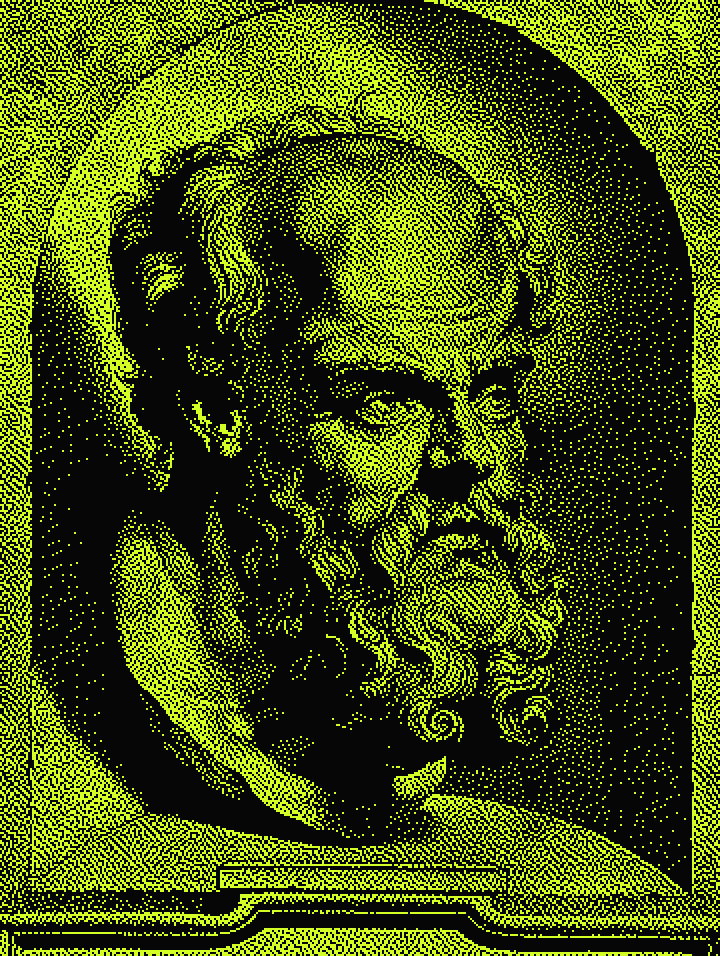
In Plato’s Phaedrus, Socrates tells an Egyptian story. Theuth, the god of invention, presents writing to King Thamus as a remedy for memory and wisdom. The king is unconvinced. People who learn letters, he says, will lean on external marks and stop exercising their own memories: “You have invented an elixir not of memory, but of reminding.” They will seem to know everything, yet what they have is “the appearance of wisdom, not true wisdom”. Writing, Socrates adds, is like a figure in a painting: whatever you ask it, it says nothing, and it is the same whoever’s hands it falls into; “when ill-treated or unjustly reviled it always needs its father to help it”.1 This complaint, more than two thousand years old, sounds very like today’s worries about AI: what we get is the outward form of an answer, not understanding. I discussed the story in What Is Technology?, and concluded that Theuth and Thamus were both right. They differ only over whether writing is an external tool that might be lost at any moment, or an element already embedded in the environment of our lives.2 Writing does damage memory, but it also reconstitutes the way we remember; our worries about AI should probably be weighed on the same scales.
The ancient Chinese had the same misgivings. In the “Way of Heaven” chapter of the Zhuangzi, Duke Huan of Qi is reading in his hall when Bian the wheelwright, at work on a wheel below, comes up and asks what he is reading. The words of the sages, the duke replies. And are the sages still alive? They are dead. “Then what my lord is reading is nothing but the dregs of the ancients!” For Bian, the feel for shaping a wheel is something you “get in the hand and answer with the heart; the mouth cannot put it into words”, and he cannot teach it even to his own son.3 The “Appended Statements” of the Book of Changes put it more tersely: “Writing does not exhaust speech; speech does not exhaust meaning.” But they at once offer a way out: “The sages set up images to express their meaning in full.”4 Every medium loses something, and every loss forces a new medium into being. That is the thread of this essay.
Twentieth-century media studies turned this intuition into a field of scholarship. In Understanding Media (1964) Marshall McLuhan declared that “the medium is the message”.5 In 1963 Jack Goody and Ian Watt examined “The Consequences of Literacy”, and Goody later argued that tools of thought such as lists, tables and formulae arrived with writing.67 In Orality and Literacy (1982) Walter Ong devoted a whole chapter to arguing that “writing restructures consciousness”, with one section entitled “Plato, writing and computers”.8 And in 1979 Elizabeth Eisenstein called the printing press an “agent of change” in early modern Europe.9 Not all of their conclusions hold up, but they share a starting point: media are not neutral means of transmission. In A Strong Programme for Media History I pushed that starting point further. Media are not just one factor that influences knowledge but its a priori condition: the possibility of recalling depends on the possibility of recording, and the medium of recording is the very capacity to remember. This “a priori” is itself historical, carried by the technical environment of each age.10
Oral teaching, lecturing, manuscripts, books, letters and journal articles do not form a straight line of evolution in which each new form wipes out the last. They are more like an ecology that keeps redividing its labour: when a new medium arrives, the old ones move over and carry on. So too with the paper. It is the body that print, the post and learned-society networks handed to modern science, but it is not the natural shape of knowledge. Now that AI has made writing cheap, this body has begun, for the first time, to look ill-fitting; that is exactly what the manifesto takes up in its section on why the crisis is also a turning point. To think clearly about what the next body might look like, we first need to understand how the earlier ones grew.
2Where did knowledge live before there was paper?#
The most influential strand of Western philosophy grew out of dialogue and teaching. Socrates wrote nothing. Plato founded his Academy outside Athens in about 387 BC.11 Aristotle entered it at seventeen and stayed until Plato died; in 335 BC he opened his own school at the Lyceum in Athens. He too wrote dialogues for the reading public, and Cicero praised his prose as “a flowing river of gold”; but these carefully polished works are almost entirely lost. The Physics and Metaphysics we read today look more like lecture notes, drafts rewritten again and again, and records of research, originally meant for listeners inside the school.12 A whole body of the most important texts in Western scholarship began life as by-products of the lectern.
It was the same in the East. Confucius described himself as one who “transmits but does not create”. The “Treatise on Literature” in the Book of Han says: “The Analects are the words with which Confucius answered his disciples and the people of his time, and the words the disciples spoke among themselves and heard directly from the Master. At the time each disciple kept his own record. After the Master died, his followers collected them together and, after discussion, compiled them; hence the title Lunyu [‘Discussed Sayings’].”13 The recorded-sayings form preserves a conversation as it happened: who is asking, what they ask, how the teacher replies. In the “Yan Yuan” chapter, three disciples ask in turn about humaneness and receive three different answers, because teaching speaks to particular people. This flexibility, shaped to each listener, is precisely what a written system finds hardest to keep.
The European universities that arose in the twelfth and thirteenth centuries turned teaching into an institution. The “lecture” (lectio) of the day literally meant “reading”: the master took an authoritative text, such as the Four Books of Sentences that Peter Lombard compiled in the 1150s, and read and explained it passage by passage, sentence by sentence.14 Alongside the reading stood the “disputation” (disputatio): the master set a question, the students argued it out on opposing sides, and the master gave the final ruling. Most exciting were the quodlibetal disputations held in Advent and Lent, where questions could be put by anyone about anything, and which were open to people from outside the university.15 Thomas Aquinas’s Summa Theologiae is not a record of disputations, yet it follows their format throughout: first the question, then the objections, then the sed contra (“but on the other hand”), then the master’s answer, and finally a reply to each objection in turn.16 In this way the spoken clash of arguments solidified into a written structure.
In China in the same period, the academies brought lecturing to its height. In 1175 Lü Zuqian invited Zhu Xi and the brothers Lu Jiuyuan and Lu Jiuling to meet at Goose Lake Temple in Yanshan, hoping to reconcile their schools. Instead the Lus found Zhu’s learning “fragmented”, Zhu thought theirs too close to Chan Buddhism, and they parted on bad terms, their positions sharper than before.17 In 1179 Zhu Xi restored the White Deer Grotto Academy;18 in 1181 he invited his old adversary Lu Jiuyuan to lecture there on the chapter of the Analects that says “the gentleman understands what is right; the petty man understands what is profitable”. Some of the audience were “even moved to tears”, and Zhu Xi at once asked him to write the lecture down and had it carved on a stone tablet set up at the academy.19 A lecture that moved its listeners survived, in the end, thanks to a slab of stone. Zhu Xi’s everyday teaching was likewise recorded by his disciples and collected into the 140 fascicles of the Classified Conversations of Master Zhu.20
The strengths of oral teaching and lecturing are exactly what today’s paper most lacks: dialogue, instant rebuttal, presence. Listeners can interrupt on the spot, the teacher can suit the words to the listener, and mistakes come to light in question and answer. Ong points out that oral cultures are by nature agonistic, which links them to the Greek spirit of contest.8 Their weaknesses are just as plain: oral learning is hard to accumulate and hard to carry far, and its effect depends on who happens to be in the room. Pre-modern scholarly exchange was confined to one time and one place, and traditions built around classic texts and lineages of teachers were extremely fragile: in antiquity the decline of learning was the norm, and accumulation the rare exception. Nor should presence be romanticized; the supposed original immediacy may always have been an illusion. Teaching in person, by word and example, does have something irreplaceable about it, but once printed books became common, the paradigm of teaching and research inevitably reorganized itself around them, and teaching in person could only play a supporting role. The same holds, in the age of AI, for a lifetime spent poring over the texts.21 We can still talk about those lectures only because someone wrote them down: Plato wrote down Socrates, the disciples wrote down Confucius, a stonemason carved Lu Jiuyuan. The lectern needed another body to carry it on.
3Can a single book hold a whole system?#
Before printing, books were copied out word by word, and much of scholarship took the form of commentary: the classic text in the centre, surrounded by layer upon layer of glosses from successive generations. The cost of copying set the pace of knowledge. To keep teaching texts accurate, medieval universities had stationers break an approved exemplar into numbered sections and rent them out in rotation to copyists, so that several people could copy different parts of one book at the same time. This was the pecia system; scholars think it originated in Bologna around 1200, and the earliest firm record of it is a contract of 1228.22 But however carefully a text was checked, every new copy could introduce fresh errors, and a carefully corrected edition could become unrecognizable after a few rounds of copying. As Bruno Latour sums up Eisenstein’s argument, before print “no irreversible gains could be made”.23
East Asia was the first to leave the age of hand-copying behind. The earliest surviving printed text with an explicit date is the Diamond Sutra of 868, found at Dunhuang; its woodcut frontispiece shows, of all things, the Buddha preaching to Subhuti.24 The first dated printed object depicts a lecture. According to Shen Kuo’s Dream Pool Essays, during the Qingli reign of the Northern Song (1041–1048) a commoner named Bi Sheng “carved characters in sticky clay, as thin as the rim of a coin, each character a single type, and fired them to make them hard”; “to print dozens, hundreds or thousands of copies, it was marvellously fast”.25 Yet movable type long had little influence in China, where woodblock printing remained dominant; movable type truly came into its own only in Europe. Gutenberg’s Bible, printed with metal type, was completed in Mainz around 1455,26 and within less than half a century Europe had printed some 30,000 editions.27
As usual, the new medium caused anxiety. In 1492 the German abbot Johannes Trithemius wrote De laude scriptorum (In Praise of Scribes), disparaging the printing press and urging monks to go on copying by hand on parchment; yet his own catalogue of church writers went to a printer in 1494.28 Half a century later, when the Swiss scholar Conrad Gesner compiled his Bibliotheca universalis in 1545, his complaint was a different one: that “confusing and harmful abundance of books”.29 First the worry that the medium is unreliable, then the worry that there is too much of it: these two anxieties would recur with every media revolution that followed.
Printing made possible a new scholarly ambition: to build a system in a single book. Titles, tables of contents and indexes, which we assume books have always had, became standard and widespread only after printing. Works of the manuscript age often had no title and were loosely organized by topic, and readers did not explore them as closed spaces of thought but treated them as material for disputation. The self-contained, independent, absorbing book, along with private silent reading, became common only in the age of print.10 In 1543 Copernicus’s De revolutionibus was published in Nuremberg and Vesalius’s De humani corporis fabrica in Basel: one rearranged the universe, the other redrew the human body.30 Arthur Koestler called De revolutionibus “the book that nobody read”. The historian Owen Gingerich spent years tracking down copies, found 276 of the first edition and 325 of the second, and discovered that the astronomers of the day had read it quite carefully, many of them leaving notes in the margins; he estimates that the first edition ran to only four or five hundred copies.31 Few readers, but the right ones. In 1687 Newton’s Principia appeared under the Royal Society’s name; the Society had already spent that year’s publishing money on a History of Fishes, so Edmond Halley paid for the printing out of his own pocket.32
Books, too, could be fast or slow. Early in 1610 Galileo saw the moons of Jupiter through his telescope; by March he had printed the sixty-page Sidereus Nuncius (Starry Messenger) in Venice, and the first run of 550 copies soon sold out.33 In 1632 he published his Dialogue Concerning the Two Chief World Systems, in Italian rather than Latin, staging a debate between the Copernican Salviati and the Aristotelian Simplicio.34 The book kept the form of a spoken debate, but it could not really answer its readers: the following year Galileo was tried by the Inquisition over it.
On 24 November 1859 Darwin’s On the Origin of Species was published; the first printing of 1,250 copies had been snapped up by the trade at the booksellers’ sale two days earlier.35 “This whole volume is one long argument,” he wrote.36 More than a year earlier, his paper and Wallace’s had been read at the Linnean Society and printed, yet in his annual address the following May the Society’s president, Thomas Bell, remarked that the year had produced no striking discovery of the kind that transforms a field at a stroke.37 What changed the world was the book. The strength of a book is its completeness: it can lay out decades of one person’s evidence and reasoning as a system that readers can follow from beginning to end. Its weaknesses come from the same completeness. It is slow to write and expensive to print; once out, it is hard to revise and ill-suited to answering criticism. Debate has to wait for the next book, and the next book often takes years.
4Why did scholars write letters, and anagrams?#
Books were too slow, so scholars wrote letters. In 1417 the Venetian humanist Francesco Barbaro wrote to Poggio Bracciolini, who had been unearthing ancient manuscripts in monasteries, praising him as deserving immortal glory in the “republic of letters”; historians regard this as the first use of the phrase.38 The usual Chinese rendering of the phrase means “republic of correspondence”; I prefer to call it the republic of the literati. What bound it into a single whole was not so much the letters passing back and forth as printed books and, later, journals. Letters could carry news, but not the Rudolphine Tables; no correspondence network, however well developed, could replace the effects of print.10 Within the world of print, for the next three hundred years, scholars all over Europe did form a community without borders through their letters, with a few tireless correspondents at its hubs. Marin Mersenne (1588–1648), a friar in Paris working in an age that had no scientific journals, was later called “the secretary of learned Europe” on the strength of his vast correspondence, which now fills 17 published volumes. He corresponded with Descartes, Gassendi, Fermat, Hobbes and others, passing their questions and answers back and forth, and from about 1633 he organized Thursday meetings at friends’ houses, a circle he himself saw as the seed of a future academy.39
Henry Oldenburg in London was another hub. A German born in Bremen, he was one of the Royal Society’s first two secretaries (the other was John Wilkins). He kept up an enormous correspondence with scholars all over Europe, brought their letters to the Society’s weekly meetings, and drew on them for material for his own periodical.40 The network had its dangers: in the summer of 1667, with England at war with the Dutch, his foreign correspondence brought him under political suspicion, and he spent just over two months in the Tower of London, from 20 June to 26 August.41 Letters were also slow: the letter Newton sent to Leibniz through Oldenburg on 24 October 1676 did not arrive until the following June.42 But the virtue of a letter was its informality. It could discuss unfinished work, or contain nothing but a conjecture, a problem or a single objection. Leibniz left some 15,000 letters, exchanged with about 1,100 correspondents.42
Letters also served to register priority. In July 1610 Galileo found that Saturn seemed to be made up of three bodies. Unwilling to go public too soon but afraid of being beaten to it, he sent his correspondents a jumble of 37 letters, smaismrmilmepoetaleumibunenugttauiras, whose solution was a Latin sentence: “I have observed the highest planet to be threefold.” The historian Albert Van Helden comments that before the scientific paper (invented in the 1660s), this was an effective, though not foolproof, way of claiming priority.43 In 1676 Hooke slipped ceiiinosssttuv into a book about instruments for observing the Sun, and only two years later revealed the solution, ut tensio, sic vis, “as the extension, so the force”: Hooke’s law.44 The anagram was a compromise, a way to register a claim without giving away the secret.
Private correspondence could not settle disputes. In 1957 Robert K. Merton surveyed the endless quarrels over priority in the history of modern science and argued that they were not just a matter of personal temperament but the product of an institution that holds originality to be the highest honour.45 The most famous was between Newton and Leibniz. Leibniz appealed to the Royal Society, but the Society’s committee never heard his side of the case; its report was written by Newton himself and published early in 1713 as the Commercium Epistolicum, turning decades-old letters into evidence.42 Two years later Newton reviewed the report, anonymously, in the Philosophical Transactions.46 The rights and wrongs of the Republic of Letters had to be decided by an institution outside the letters, and that institution was not necessarily fair either. Scholars needed a register that was public, dated and open to all.
5How was the journal born?#
On Monday 5 January 1665 a periodical called the Journal des sçavans appeared in Paris; it is generally regarded as the first scholarly journal. Its founder, Denis de Sallo, writing as “the Sieur de Hédouville”, set out to report regularly on new books in Europe, the deaths of famous people, court judgements and new discoveries in every branch of learning.47 It was more like a weekly newspaper for men of letters, made up mostly of book reviews; after 13 issues it offended the authorities and was suspended, resuming only the following year.47 Two months later, in London, Oldenburg launched the Philosophical Transactions. Its first issue was dated “Munday, March 6. 1664/5” (England still used the Julian calendar and began the new year on 25 March; by the Gregorian calendar used in Paris, the day was 16 March).48 It had the Royal Society’s licence, but it was in fact Oldenburg’s private venture, and he alone bore the costs.49
Today the table of contents of that first issue reads like a shopping list: news of improved optical lenses from Rome; Hooke’s observation of a spot on one of Jupiter’s belts; a prediction of a comet’s motion; a monstrous calf; whaling around Bermuda; trials of pendulum watches for finding longitude at sea; and a life of the recently deceased Fermat.48 In his introduction Oldenburg promised to pass on the studies and discoveries of “the Curious and learned in things of this kind” to others engaged in the same pursuits, in order to advance “solid and usefull knowledge”.48 That is what early journals were: hybrids, half news and book reviews, half extracts from letters and reports of experiments. They took the internal correspondence of the Republic of Letters, printed it and made it public. The scholarly journal has its roots in a “public mailbox”: the Philosophical Transactions was founded on a network of scholarly correspondents, and the network organized through these “open letters” mattered more than “publication” as such. From the very start the paper was not a monologue but a conversation.10
Most early “papers” were simply letters. When Newton published his new theory of light and colours in 1672, the title spelled it out: “A Letter of Mr. Isaac Newton, Professor of the Mathematicks in the University of Cambridge … Sent by the Author to the Publisher from Cambridge, Febr. 6. 1671/72; In Order to be Communicated to the R. Society”.50 It was first read at the Society’s weekly meeting and then printed in the Philosophical Transactions. We still speak of “reading a paper”, a relic of this history; as late as the 1820s, many journals were still largely accounts of the meetings at which papers had been read in academies and societies.51 Journals made letters public, and disputes along with them: Newton’s paper drew four years of objections from Hooke, Huygens and others, which so exasperated him that he resolved to withdraw from public controversy.46 His Opticks did not appear, as a book, until 1704, by which time Hooke was dead. Charles Bazerman, who studies scientific genres, discusses this episode in a chapter titled “Between Books and Articles”.52
In hindsight, the journal served several functions from the outset. Information scientists later summed them up as registration (recording who first proposed what, and when), certification (judging whether a claim is credible), dissemination (letting peers know) and archiving (making sure later generations can find it).53 When Harriet Zuckerman and Robert Merton traced the origins of refereeing in 1971, they placed the journal within science’s reward system: publication both registered priority and won recognition from peers.54 What anagrams and private letters did badly, journals did well. Every issue carried a date, the same words appeared on many shelves at once, and nobody could alter them after the fact. Certification was another matter: refereeing arrived later than most people imagine (see section 7 of this essay).
Before refereeing existed, certification was first of all a technology of writing. Around 1660, Robert Boyle, experimenting with an air pump in Oxford, made a point of inviting witnesses of standing, but a laboratory can only hold so many people. Steven Shapin noticed that Boyle’s reports were unusually long-winded: they spelled out the apparatus, the procedures and who was present, and recorded even the failed attempts, so that readers who had not been there could reconstruct the scene in their minds. Shapin called this “virtual witnessing”: richly detailed prose that widened the circle of witnesses to take in every reader.5556 This is in the paper’s genes. The methods section of a paper today is still, in essence, an invitation: you need not take my word for it; you can do it again yourself. Science was once a public performance, and the paper moved the auditorium onto the page.
6When did the paper become the output of a profession?#
At the start of the nineteenth century, English still had no generally accepted name for people who studied nature; the usual terms were phrases such as “natural philosopher” or “man of science”. In 1834 William Whewell anonymously reviewed Mary Somerville’s On the Connexion of the Physical Sciences in the Quarterly Review. Members of the British Association for the Advancement of Science, he wrote, had met at York, Oxford and Cambridge three summers running, yet had no word for themselves: “philosophers” was too broad and too lofty, and the poet Coleridge objected to their calling themselves that; so “some ingenious gentleman proposed that, by analogy with artist, they might form scientist”, though the suggestion found little favour.57 The ingenious gentleman was in fact Whewell himself, answering a challenge from Coleridge in 1833.58 In 1840, in The Philosophy of the Inductive Sciences, he wrote: “We need very much a name to describe a cultivator of science in general. I should incline to call him a Scientist.”59 In the same 1834 review he lamented that science was splitting into ever narrower branches and “loses all traces of unity”.57 The new word was born together with anxiety about specialization; that cost is discussed further under the triumph and cost of specialization.
Specialization showed itself first in journals. In 1826 August Leopold Crelle founded the Journal für die reine und angewandte Mathematik in Berlin, a periodical devoted entirely to mathematics. Unlike the journals of the time, which mainly reported the meetings of academies, it was run single-handedly by its editor and carried only research articles; its first volume published the young Norwegian Niels Henrik Abel’s proof that the quintic equation cannot be solved by radicals.51 In Paris, from 1835 the Academy of Sciences published its weekly Comptes rendus, rushing into print the short papers presented at its sessions. Faster, shorter, more frequent publication changed the rhythm of scientific writing, and forced learned societies to rethink who was entitled to publish and who should be the judge.6061
Another thread runs through the universities. Nineteenth-century German universities, built on the ideal of uniting teaching and research, became the model for the research university. The chemist Justus von Liebig taught at Giessen for nearly thirty years, from 1824 to 1852; he edited the Annalen der Chemie und Pharmacie, which became the leading journal of chemistry, and built a teaching laboratory that could train large numbers of students at once, a model widely copied, first in Europe and later in America.62 Students worked on projects in the laboratory, earned their degrees with research papers, and then used their publications to seek academic posts. Science changed from a gentleman’s pastime into a profession with entry requirements, training and a career ladder, and papers were the rungs of that ladder.
By the middle of the nineteenth century the paper had become the unit by which scientists were measured. From 1867 the Royal Society issued its Catalogue of Scientific Papers, which arranged by author the scientific papers published in periodicals since 1800. The historian Alex Csiszar shows that the catalogue projected a novel view of the history of science back onto the whole century: knowledge was built up from discrete papers, each tied to an author, and a scientist’s life could be represented as a list of papers. Intended as a finding aid, it was soon being used to measure scientists’ output and reputation.63 Csiszar also argues that the familiar genre of the “scientific journal” itself took its settled form only through the political, technical and economic struggles of the nineteenth century.60 The paper has been the scientist’s standard output and unit of credit for no more than a century and a half. How the profession later turned into an assembly line is the subject of how research was broken up into an assembly line.
7Has there always been peer review?#
Many people assume that peer review was born together with the journal. It was not. When Oldenburg edited the Philosophical Transactions, his material came from his correspondence, the Society’s weekly meetings and newly published books, and what went in was his decision alone.40 In 1752, after an internal crisis, the Royal Society formally took the journal over. From then on it was published “for the sole use and benefit of this Society”, paid for by members’ subscriptions and edited by a standing “Committee of Papers”.49 The committee voted on which of the papers read at meetings should be printed.40 Noah Moxham and Aileen Fyfe point out that this kind of vetting had more to do with a gentlemanly society’s collective responsibility, its finances and the distribution of honour than with quality control in today’s sense. They also note that it was Zuckerman and Merton’s 1971 discussion of the early Royal Society that led many later writers to project “peer review” back onto the 1660s.64
At the Royal Society, written referee reports appeared only in the 1830s; the Paris Academy, by contrast, had been appointing academicians to write joint reports on outside submissions since the eighteenth century. In 1831 the Royal Society experimented with reports written jointly by several fellows; from 1832 it asked referees to write their reports independently, for the guidance of the Committee of Papers. Refereeing soon became a routine step at learned societies.40 But most journals outside the societies were long run by their editors, and a journal was often known as “Editor X’s journal”.40 Nature is a case in point. The two editors who took over in 1939 often published papers directly on the recommendation of scientists they trusted, and their successor, John Maddox, would also print papers he liked without sending them out for review; not until 1973 did the editor David Davies make external review a condition of publication. From this Melinda Baldwin concludes that as late as the 1960s a journal without systematic external review could still count as a respectable scientific journal.65
Einstein’s experience is telling. In 1936 he and Nathan Rosen submitted a paper to the American journal Physical Review arguing that gravitational waves do not exist. The editor, John Tate, sent the manuscript to an anonymous expert, who pointed out a mistake. Einstein replied on 27 July: “We (Mr. Rosen and I) had sent you our manuscript for publication and had not authorized you to show it to specialists before it is printed. I see no reason to address the—in any case erroneous—comments of your anonymous expert.” He preferred to publish elsewhere. The referee was later identified as the cosmologist Howard Percy Robertson; by the time the paper appeared in the Journal of the Franklin Institute, its conclusion had become a solution describing cylindrical gravitational waves.66 To a physicist raised in the German journal system, anonymous refereeing was unfamiliar, even insulting.
The term “peer review” is younger still. The earliest use recorded in the Oxford English Dictionary dates from 1967 and refers to review by peers in hospitals; the first academic example dates from 1971.64 Baldwin’s research shows that the idea that only peer-reviewed work counts as legitimate science first took hold in the United States during the Cold War. In the 1970s, after a series of attacks on research funding, scientists had to answer to those who paid for their work while wanting to keep expert control over how the money was shared out, and so they made “peer review” into the key procedure that guaranteed the credibility of science as a whole.67 Csiszar puts it more generally: the turning points in the history of refereeing have tended to come at moments when the public standing of science was being renegotiated.68 Peer review is not an organ the paper was born with; it grew later and was then loaded with symbolic meaning. Only with that in mind can we calmly discuss its bottlenecks today.
8When did people start counting papers?#
In the mid-twentieth century the number of papers itself became an object of research. The story is often told as beginning in Singapore. While teaching applied mathematics at the University of Malaya, the physicist Derek de Solla Price stacked a complete run of the Philosophical Transactions against a wall, one pile per decade, and found that the heights of the piles traced a beautiful exponential curve. Historians caution that the legendary aura of this “eureka moment” owes something to Price’s self-promotion.69 In Little Science, Big Science (1963) he used data from abstracting journals to argue that the scientific literature doubled roughly every 15 years;7071 two years later he summarized the picture: science was growing at a compound rate of about 7% a year, and had grown roughly a millionfold in the three hundred years since the scientific paper was invented in the seventeenth century.72 These figures are not consistent with one another,71 but recent bibliometric research still supports the big picture of long-term exponential growth. Measured by cited references, science grew by less than 1% a year until the mid-eighteenth century, by about 2–3% a year from then until the period between the two world wars, and by 8–9% a year from then until 2012.73
More papers called for new tools to search them. In 1955 Eugene Garfield proposed in Science the creation of a citation index for science, and mentioned for the first time the idea of an “impact factor”.74 In 1964 the Institute for Scientific Information, which he had founded, launched the Science Citation Index; to decide which journals to include, he and his colleague Irving Sher invented the journal impact factor, and from 1975 the annual Journal Citation Reports published rankings of journals.7576 Late in life Garfield admitted that the Science Citation Index owed its success not to its proper job of retrieval but to its use as an instrument for measuring scientific productivity.76 The Victorian list of papers had become a number that could be ranked, and that road leads straight to today’s metrics and “paper-counting”.
The flood of papers also fattened commercial publishing. In 1951 Robert Maxwell, a Czech-born businessman, paid £13,000 for control of a scientific publishing company, which was soon renamed Pergamon Press. After the war, governments were pouring money into science and university libraries were flush with funds. Pergamon’s method was to convince a leading scholar in a field that the field needed a new journal, invite him to edit it, and then sell subscriptions to libraries. In 1959 Pergamon published 40 journals; six years later it published 150. In 1991 Maxwell sold it to Elsevier for £440 million.77 Commercial scientific journals had already been common in the nineteenth century (the Philosophical Magazine and Nature were both privately published), but after the war journal publishing became a big and highly profitable business.
Style was being standardized too. The “introduction, methods, results and discussion” (IMRaD) structure now usual in medicine and the life sciences evolved from the letter form and the purely descriptive styles of the seventeenth century. A sample of four leading medical journals shows that it began to appear in the 1940s, accounted for 80% of articles by the 1970s, and in the 1980s became the only format for original papers.78 A phrase also began to circulate in academia. In The Academic Man (1942) the sociologist Logan Wilson wrote that the pressures of their situation had produced a “publish or perish” credo among academics; in 1951 Marshall McLuhan, writing to the poet Ezra Pound, sneered that it was the universities’ motto.79 In the era of big science the list of authors on a single paper could become astonishingly long: the 2015 paper in which the ATLAS and CMS collaborations jointly measured the mass of the Higgs boson had more than 5,000 authors.80 The paper was still the unit of credit, but the meaning of the word “author” had quietly changed.
9Lectern, book, paper: which replaced which?#
The triumph of the paper did not make other media disappear, and different disciplines still divide the labour in different ways. Computer science relies mainly on conference papers: the Computing Research Association’s 1999 guidelines on promotion and tenure state explicitly that “for experimentalists conference publication is preferred to journal publication”, and that computational artefacts such as software and chips are also a tangible means of conveying ideas.81 The humanities still treat the monograph as the “gold standard”: a 2006 survey by the Modern Language Association found that in doctorate-granting institutions 88.9% of departments rated publication of a monograph “very important” or “important” for tenure, and nearly half also required progress on a second book.82 Each discipline has chosen a body to suit the shape of its own knowledge.
Nor has the lectern ever left the stage. In 1825 the Royal Institution in London began its Christmas Lectures for young people, which have been given every year since, except during the Second World War. Faraday alone gave 19 series; his lectures on “The Chemical History of a Candle”, delivered in 1848 and 1860, were turned into a book in 1861 that is still in print.83 Lectures became books, and books brought new audiences back to lectures. From 2006 the TED conference put its talks online free of charge, and within a few months they had been viewed more than a million times;84 in 2012 Coursera and edX were founded in quick succession, opening courses from leading universities to the whole world.8586 None of these forms can replace the paper, and the paper cannot replace them. The lectern excels at presence, passion and demonstration; it can make a stranger feel, for the first time, that a question is worth caring about, and that is exactly where wonder happens.
Images are another medium that is often underrated. In 1665, the year the Philosophical Transactions was founded, Hooke published Micrographia, in which a flea, a louse and the compound eye of a fly were engraved on large copper plates. Samuel Pepys sat up until two in the morning reading it and called it the most ingenious book he had ever read in his life.87 Vesalius’s anatomical plates and the single branching diagram in On the Origin of Species are arguments that words cannot replace. The principle of “setting up images to express meaning in full” has been borne out again and again in the history of science; it is just that the cost of printing made later papers ever more reliant on text, with images squeezed into a few figures.
In a BBC radio talk in 1963, the immunologist Peter Medawar said that scientists publish their work almost entirely in papers rather than in books.88 It would be more accurate to say that the paper occupies the centre of registration and certification, while books keep synthesis and system, the lectern keeps presence and enlightenment, and private exchange keeps unfinished work and tentative probing; email, conference corridors and discussion threads on social media are all descendants of the Republic of Letters. The hallmark of the book is self-sufficiency: it is one person’s monologue, in which readers can immerse themselves, which is why philosophers must write monographs. The paper depends on an existing scholarly community; it is a conversation, a small advance added to what others have done, and it is read by searching and browsing. Lectures and blogs are more open and more bound to context, and their words are never cut off from their author. I once compared all this to a castle. Monographs are the rooms where one lingers; talks, papers and blogs are the squares, cloisters and passageways. A castle needs spaces that open out as well as spaces that enclose, and a castle without rooms attracts only passing visitors.10 Media do not so much replace one another as divide the labour, and the shape of that division depends on what each age finds scarcest.
10How do media shape knowledge?#
Media do not merely carry knowledge; they shape what counts as knowledge. Ong describes how knowledge in oral cultures stays close to life, depends on its situation, and has to be held in memory through formulas and repetition. Writing separates discourse from the speaker, producing “autonomous” discourse that can stand on its own and be examined again and again, and this makes precise definitions and long chains of argument possible. Print then brings a “sense of closure”, making texts seem complete and settled, fit to be catalogued and indexed.8 The paper is the product of both writing and print: it detaches research from the researcher and packs it into a box with clear edges and fixed page numbers that can be cited. This is not to say that technology single-handedly determines knowledge. Media ecology does not promise any natural law of technological development independent of human society; technology and culture are two sides of the same coin, and it is pointless to ask which determines the other. Nor did printing simply make communication faster and wider. It was more like a catalyst dropped into a great mass of raw material, speeding up some reactions and holding back others: a twist with a bias of its own, not mere acceleration.10
Historians still argue about what exactly print changed. Eisenstein stressed print’s “fixity”: because hundreds or thousands of copies of a text were identical, comparison, correction and accumulation became possible.9 In The Nature of the Book (1998) Adrian Johns countered that fixity is not an inherent property of the press. In seventeenth-century London, piracy, tampering and false attribution were everywhere, and whether a printed book could be trusted depended on a whole set of norms of credit among authors, printers, booksellers and readers.89 I prefer to speak of “standardization” rather than “fixity”. Early printed books were just as riddled with errors; what mattered was that they could issue errata lists, so that behind all the variously flawed copies in circulation there stood a most accurate original that could be approached step by step. The differences between manuscript copies were murky, whereas different editions of a printed book were clearly distinct and could be set against one another and criticized. That is how Ptolemy became a contemporary of Copernicus.10 Nor is the reliability of the paper conferred automatically by type; it has to be maintained jointly by editors, societies, referees, libraries and habits of citation. Once these arrangements loosen, no amount of neat printing will help.
Latour called things such as maps, charts, specimens and statistical tables “immutable mobiles”: they can be carried far away without distortion, and they can be laid side by side, taken in at a glance and combined.23 The scientific paper may be the most successful of them all; an issue of a journal is a bundle of immutable mobiles, dated, bound and posted. A paper can be sent from Singapore to London, or kept from 1665 to 2026, without a word changing; its charts and tables can be cited, superimposed and compared; and thousands upon thousands of papers, strung together by citations, become what Price called “networks of scientific papers”.72
But immutability has its price. Bazerman traced how the experimental report evolved in the Philosophical Transactions from 1665 to 1800 and in the Physical Review from 1893 to 1980, and saw it change from a narrative of how a particular experiment went into a highly formalized argument framed by theory and the literature.52 The impersonal tone, the passive voice, the separate methods section, the order of review first and results after: all of these detach the text from particular people and settings, as if nature itself were stating the facts. This is how the paper manufactures “objectivity”. In that radio talk Medawar asked: is the scientific paper a fraud? His answer was yes. Not in the sense that the paper misrepresents the facts, but in the sense that it misrepresents the thinking that produced the work: the orthodox form of the paper, he argued, embodies “a totally mistaken conception, even a travesty, of the nature of scientific thought”, as if the researcher’s mind were an empty vessel waiting for facts to pour in from outside.88
Which brings us back to Bian the wheelwright’s problem. The paper is good at carrying claims that can be stated, cited and attributed to an author, but it struggles to carry the craft that you “get in the hand and answer with the heart”, the detours that led nowhere, the data thrown away and the researcher’s hesitations. The manifesto likens the world of the literature to a city of survivors; this is no moral failing of any particular author, but a consequence of how this body is built. Every medium has its blind spots: speech cannot remember, writing cannot answer back, books are too slow, letters too private, papers too narrow. The point of recognizing this is not to belittle the paper but to know where its boundaries lie, and what lies beyond them (see section 9 of this essay).
11What will the next body look like?#
Taken as a whole, each medium answered the most pressing problem of its age: lecturing solved teaching and debate; books, system and preservation; letters, communication at a distance; journals, registration, certification and accumulation among strangers; citation indexes, retrieval under information overload. But a new medium never merely answers old questions. It also creates problems that the old age could not have imagined: before print, no one fretted about there being too many books, and there were no priority disputes in today’s sense. A new medium is not so much a tool serving old ends as a producer of new ones. Today the most pressing problem has changed. Digitization merely traded paper for digital paper: the PDF still imitates the printed page. Generative AI, meanwhile, has made “getting it written” almost free. What is scarce is no longer text but verification, clear explanation and judgement. The paper as a body was designed for an age of scarcity: it assumes that writing is expensive, space is limited, readers are peers, and registering a result once is enough. One by one, these assumptions are failing.
The next body will probably need several properties. It must be layered: for one and the same piece of research, peers read the core argument, beginners read a guide, those replicating it open the data and code, and the public watches a short explanation. The manifesto calls this a knowledge object, and the seven layers of a work sketches the idea in more concrete form. It must be linkable: in 1945 Vannevar Bush imagined a machine called the Memex that would let readers string documents together by association into paths they could walk again and again, a wish only half fulfilled in the history that runs from the Memex to the World Wide Web.90 It must be executable: computer science has long recognized software as a scholarly output, and a methods section can be a piece of code that runs. And it must be able to converse: Socrates complained that writing cannot answer questions; now, for the first time, AI has made texts “speak”.
Texts that answer back raise new problems. When AI answers on behalf of a paper, is it giving the author’s meaning or the model’s guess? Socrates said that writing, when ill-treated, “always needs its father to help it”; in the new body this father, the author, has to be present in a different way: through version histories, links to evidence, automatic records of AI involvement and discussions that can be traced. This is precisely the question the manifesto’s new standards must answer, and the question Boyle answered with his long-winded reports more than three hundred years ago: how to earn the trust of people who were not there.
So the next body will not be a simple substitute for the paper. More likely it will bring a new division of labour: the lectern returns to the scene of research through video and live streaming, books go on carrying synthesis, letters become real-time discussion threads, and the paper retreats to its core position of registration and certification, handing explanation, data, process and dialogue over to new layers. There are two things I do not want to fudge. The first is that the new body must leave room for immersion. The meaning of a good book lies precisely in what cannot be compressed; a layered, clickable network still needs rooms where people can linger, or it will merely replace “reading” with “scrolling” and hand scholarship over to the logic of traffic.91 The second is reflexivity. In writing this essay I am still using the print age’s standards for what an “essay” is (sections, notes, a final version), and in the end it will still be judged from the standpoint of the printed book. No one designs a new body; only after the whole environment has rearranged itself around the new medium will we see how it really differs from the old one. More than seventy years ago, the exponential curve Price saw in Singapore measured the height of bookshelves. The question today is no longer how high the books can be piled, but what shape knowledge must grow into for people to be able to walk back into it.
※Sources
- 1
Plato, Phaedrus 274c–277a. Chinese translation quoted from Wang Xiaochao 王晓朝 (trans.), 《柏拉图全集》 [Complete works of Plato], vol. 2 (People’s Publishing House 人民出版社, 2017), pp. 197–199 (that translation renders the king’s name as 萨姆斯), as cited in Hu Yiqing 胡翼青 and Fang Jieyu 方婕妤, “栖身媒介史的断点:论柏拉图的媒介思想” [Dwelling at a break in media history: on Plato’s thought about media], Chinese Journal of Journalism & Communication 国际新闻界, 2025, no. 11. English quotations from the translation by H. N. Fowler (Loeb Classical Library, 1914). aisixiang.com/data/179983.html ; cts.perseids.org/read/greekLit/tlg0059/tlg012/perseus-eng2/275 ↩
- 2
Hu Yilin 胡翌霖, 《什么是技术》 [What is technology?] (Hunan Science & Technology Press 湖南科学技术出版社, 2020). ↩
- 3
Zhuangzi 《庄子》, “Tian dao” 天道 [The way of heaven], the passage on Wheelwright Bian cutting a wheel (轮扁斫轮). ctext.org/zhuangzi/tian-dao/zh ↩
- 4
Zhouyi 《周易》 [Book of changes], “Xici shang” 系辞上 [Appended statements, part 1]. ctext.org/book-of-changes/xi-ci-shang/zh ↩
- 5
Marshall McLuhan, Understanding Media: The Extensions of Man (McGraw-Hill, 1964). openlibrary.org/works/OL871783W ↩
- 6
Jack Goody and Ian Watt, “The Consequences of Literacy”, Comparative Studies in Society and History 5, no. 3 (1963): 304–345. doi.org/10.1017/S0010417500001730 ↩
- 7
Jack Goody, The Domestication of the Savage Mind (Cambridge University Press, 1977). openlibrary.org/works/OL470152W ↩
- 8
Walter J. Ong, Orality and Literacy: The Technologizing of the Word (Methuen, 1982); 30th-anniversary edition (Routledge, 2012), whose table of contents includes chapter 4, “Writing restructures consciousness”, and within it the section “Plato, writing and computers”. routledge.com/Orality-and-Literacy-30th-Anniversary-Edition/O… ↩↩2↩3
- 9
Elizabeth L. Eisenstein, The Printing Press as an Agent of Change: Communications and Cultural Transformations in Early-Modern Europe (Cambridge University Press, 1979). doi.org/10.1017/CBO9781107049963 ↩↩2
- 10
Hu Yilin 胡翌霖, 《媒介史强纲领:媒介环境学的哲学解读》 [A strong programme for media history: a philosophical reading of media ecology] (The Commercial Press 商务印书馆, 2019). ↩↩2↩3↩4↩5↩6↩7
- 11
J. J. O’Connor and E. F. Robertson, “The Academy of Plato”, MacTutor History of Mathematics, University of St Andrews, accessed 30 September 2026. mathshistory.st-andrews.ac.uk/Societies/Plato/ ↩
- 12
Christopher Shields, “Aristotle”, Stanford Encyclopedia of Philosophy, first published 2008, revised 2020. plato.stanford.edu/entries/aristotle/ ↩
- 13
Ban Gu 班固, Hanshu 《汉书》 [Book of Han], “Yiwen zhi” 艺文志 [Treatise on literature]. ctext.org/han-shu/yi-wen-zhi/zh ↩
- 14
Philipp W. Rosemann, The Story of a Great Medieval Book: Peter Lombard’s Sentences (Broadview Press, 2007). openlibrary.org/works/OL8004278W ↩
- 15
Br. Innocent Hillman, O.P., “Intellectual Almsgiving”, Dominicana, 11 November 2025. dominicanajournal.org/intellectual-almsgiving/ ↩
- 16
Alfred J. Freddoso, “The Structure of a Medieval Quaestio, e.g. Each Article in the Summa Theologiae”, course handout, University of Notre Dame, accessed 30 September 2026. www3.nd.edu/~afreddos/courses/intro/quaestio.htm ↩
- 17
Xu Ning 许宁, “‘道问学’与‘尊德性’:从‘鹅湖之会’说起” [“Pursuing inquiry and learning” and “honouring the moral nature”: starting from the Goose Lake meeting], Chinese Social Sciences Net 中国社会科学网, 28 May 2025. cssn.cn/skgz/bwyc/202505/t20250528_5876096.shtml ↩
- 18
Li Jianfa 李建发 and Yu Xianhong 余贤红, “‘书院之首’:鹿鸣高咏共弦歌” [“First among academies”: chanting the Deer Cry to the strings], Banyuetan, internal edition 半月谈内部版, 2023, no. 10; reprinted by Confucian Net 儒家网. rujiazg.com/article/26592 ↩
- 19
Li Yi 李毅, “《白鹿洞书院〈论语〉讲义》中的‘学’与‘仕’” [“Learning” and “office” in the White Deer Grotto Academy Lecture on the Analects], Study Times 学习时报, 10 March 2025; reprinted by Confucian Net 儒家网. rujiazg.com/article/29635 ↩
- 20
Confucian Net 儒家网, “《朱子语类》简体横排标点本出版暨简介、目录” [A punctuated edition of the Classified Conversations of Master Zhu in simplified characters and horizontal setting is published: introduction and table of contents], 18 December 2018. rujiazg.com/article/15491 ↩
- 21
Hu Yilin 胡翌霖, 《AI会重构科学史吗》 [Will AI reconstruct the history of science?], Suixuan 随轩 (yilinhut.net), 24 March 2026. yilinhut.net/2026/03/24/10005.html ↩
- 22
Jeremy Norman, “Introduction of the Pecia System, an Advance in Text Manuscript Production”, HistoryofInformation.com (citing L. E. Boyle 1986 and others), accessed 30 September 2026. historyofinformation.com/detail.php?id=244 ↩
- 23
Bruno Latour, “Visualisation and Cognition: Thinking with Eyes and Hands”, Knowledge and Society: Studies in the Sociology of Culture Past and Present 6 (1986): 1–40 (the text on the author’s website is titled “Visualisation and Cognition: Drawing Things Together”). bruno-latour.fr/sites/default/files/21-DRAWING-THINGS-TOGETHE… ↩↩2
- 24
Jeremy Norman, “The Diamond Sutra, the Earliest Surviving Dated Complete Printed Book”, HistoryofInformation.com, accessed 30 September 2026; see also Linda Hall Library, “The Diamond Sutra” (Scientist of the Day). historyofinformation.com/detail.php?id=207 ↩
- 25
Shen Kuo 沈括, Mengxi bitan 《梦溪笔谈》 [Dream pool essays], juan 18, “Jiyi” 技艺 [Skills], entry “Huoban” 活板 [Movable type]; for the dates see China Intangible Cultural Heritage Network 中国非物质文化遗产网, “中国活字印刷术” [Chinese movable-type printing]. ihchina.cn/printing_information_detail/26003.html ↩
- 26
Library of Congress, “The Gutenberg Bible” (Bible Collection exhibition). loc.gov/exhibits/bibles/the-gutenberg-bible.html ↩
- 27
Consortium of European Research Libraries (CERL), Incunabula Short Title Catalogue (ISTC), accessed 30 September 2026. data.cerl.org/istc/ ↩
- 28
University of Missouri Libraries Special Collections, “Incunables: Other Religion” (entry for Trithemius, Liber de Scriptoribus Ecclesiasticis, Basel, 1494), accessed 30 September 2026. library.missouri.edu/specialcollections/exhibits/show/incunab… ↩
- 29
Ann Blair, “Reading Strategies for Coping With Information Overload ca. 1550–1700”, Journal of the History of Ideas 64, no. 1 (2003): 11–28. doi.org/10.1353/jhi.2003.0014 ↩
- 30
U.S. National Library of Medicine, “Historical Anatomies on the Web: Vesalius, De corporis humani fabrica libri septem (Basel: Johannes Oporinus, 1543)”, accessed 30 September 2026. nlm.nih.gov/exhibition/historicalanatomies/vesalius_bio.html ↩
- 31
Harvard Magazine, “The Copernicus Quest” (on Owen Gingerich’s census of De revolutionibus), November–December 2003. harvardmagazine.com/2003/11/the-copernicus-quest.html ↩
- 32
Pembroke College, Oxford, “#26 Philosophiae Naturalis Principia Mathematica”, accessed 30 September 2026. pmb.ox.ac.uk/26-philosophiae-naturalis-principia-mathematica ↩
- 33
Linda Hall Library, “Three Bright Galilean Stars: Three Copies of Sidereus Nuncius in Kansas City”, accessed 30 September 2026. lindahall.org/about/news/three-bright-galilean-stars-three-co… ↩
- 34
J. J. O’Connor and E. F. Robertson, “Galileo Galilei”, MacTutor History of Mathematics, University of St Andrews, accessed 30 September 2026. mathshistory.st-andrews.ac.uk/Biographies/Galileo/ ↩
- 35
R. B. Freeman, “On the Origin of Species” (bibliographical introduction), The Complete Work of Charles Darwin Online, accessed 30 September 2026. darwin-online.org.uk/EditorialIntroductions/Freeman_OntheOrig… ↩
- 36
Charles Darwin, On the Origin of Species by Means of Natural Selection (John Murray, 1859), opening of chapter 14 (Project Gutenberg text of the first edition). gutenberg.org/files/1228/1228-h/1228-h.htm ↩
- 37
The Linnean Society of London, “1st July 2018: 160th anniversary of the presentation of ‘On the tendency of Species to form Varieties’”, 1 July 2018. linnean.org/the-society/news/2018/07/01/1st-july-2018-160th-a… ↩
- 38
Peter N. Miller, “Marc Fumaroli: Passionate Master”, The New York Review of Books, 9 July 2015. nybooks.com/articles/2015/07/09/marc-fumaroli-passionate-master/ ↩
- 39
Philippe Hamou, “Marin Mersenne”, Stanford Encyclopedia of Philosophy, first published 2018, revised 2022. plato.stanford.edu/entries/mersenne/ ↩
- 40
Aileen Fyfe, “Peer Review: Not as Old as You Might Think”, Times Higher Education, 25 June 2015. timeshighereducation.com/features/peer-review-not-old-you-mig… ↩↩2↩3↩4↩5
- 41
Royal Society Archive catalogue, “Oldenburg; Henry (c 1619 - 1677); natural philosopher and scientific correspondent” (person record NA8001: imprisoned in the Tower of London on suspicion that his foreign correspondence was political, 20 June – 26 August 1667), accessed 1 October 2026; for a contemporary account see Samuel Pepys, Diary, 25 June 1667. catalogues.royalsociety.org/CalmView/Record.aspx?src=CalmView… ; pepysdiary.com/diary/1667/06/25/ ↩
- 42
J. J. O’Connor and E. F. Robertson, “Gottfried Wilhelm von Leibniz”, MacTutor History of Mathematics, University of St Andrews, accessed 30 September 2026. mathshistory.st-andrews.ac.uk/Biographies/Leibniz/ ; numbers of letters and correspondents from Gottfried Wilhelm Leibniz Bibliothek, “UNESCO Weltdokumentenerbe in der GWLB”, accessed 30 September 2026. gwlb.de/die-bibliothek/weltdokumentenerbe ↩↩2↩3
- 43
Albert Van Helden, “Saturn”, The Galileo Project, Rice University, 1995. galileo.rice.edu/sci/observations/saturn.html ↩
- 44
American Institute of Physics, Niels Bohr Library & Archives, “Introducing Laws of Physics” (Ex Libris Universum exhibition), accessed 30 September 2026. aip.org/library/ex-libris-universum/introducing-laws-of-physics ↩
- 45
Robert K. Merton, “Priorities in Scientific Discovery: A Chapter in the Sociology of Science”, American Sociological Review 22, no. 6 (1957): 635–659. doi.org/10.2307/2089193 ↩
- 46
George Smith, “Isaac Newton”, Stanford Encyclopedia of Philosophy, first published 2007. plato.stanford.edu/entries/newton/ ↩↩2
- 47
Martin Lister Project (University of Oxford), “Le Journal des Sçavans”, accessed 30 September 2026. lister.site.ox.ac.uk/le-journal-des-scavans ↩↩2
- 48
Henry Oldenburg (ed.), Philosophical Transactions 1, no. 1, 6 March 1665 (Project Gutenberg e-text, containing vol. 1, 1665–1666). gutenberg.org/files/28758/28758-h/28758-h.htm ↩↩2↩3
- 49
The Royal Society, Publishing 350: Exhibition Catalogue (catalogue of the exhibition marking 350 years of Royal Society publishing), 2015. royalsociety.org/-/media/journals/publishing/publishing-350-e… ↩↩2
- 50
Isaac Newton, “A Letter of Mr. Isaac Newton, Professor of the Mathematicks in the University of Cambridge; Containing His New Theory about Light and Colors”, Philosophical Transactions 6, no. 80 (1672): 3075–3087. doi.org/10.1098/rstl.1671.0072 ↩
- 51
J. J. O’Connor and E. F. Robertson, “August Leopold Crelle”, MacTutor History of Mathematics, University of St Andrews, accessed 30 September 2026. mathshistory.st-andrews.ac.uk/Biographies/Crelle/ ↩↩2
- 52
Charles Bazerman, Shaping Written Knowledge: The Genre and Activity of the Experimental Article in Science (University of Wisconsin Press, 1988); open edition from the WAC Clearinghouse, in which chapter 4 is titled “Between Books and Articles: Newton Faces Controversy”. wac.colostate.edu/books/landmarks/bazerman-shaping/ ↩↩2
- 53
Herbert Van de Sompel, Sandy Payette, John Erickson, Carl Lagoze and Simeon Warner, “Rethinking Scholarly Communication: Building the System that Scholars Deserve”, D-Lib Magazine 10, no. 9 (2004) (the article summarizes the functions of scholarly communication set out by Roosendaal and Geurts, 1997). dlib.org/dlib/september04/vandesompel/09vandesompel.html ↩
- 54
Harriet Zuckerman and Robert K. Merton, “Patterns of Evaluation in Science: Institutionalisation, Structure and Functions of the Referee System”, Minerva 9, no. 1 (1971): 66–100. doi.org/10.1007/BF01553188 ↩
- 55
Steven Shapin, “Pump and Circumstance: Robert Boyle’s Literary Technology”, Social Studies of Science 14, no. 4 (1984): 481–520. doi.org/10.1177/030631284014004001 ↩
- 56
Steven Shapin and Simon Schaffer, Leviathan and the Air-Pump: Hobbes, Boyle, and the Experimental Life (Princeton University Press, 1985). press.princeton.edu/books/paperback/9780691178165/leviathan-a… ↩
- 57
[William Whewell], “On the Connexion of the Physical Sciences. By Mrs. Somerville”, The Quarterly Review 51 (1834): 54–68 (quotation on p. 59). archive.org/details/quarterlyreview47smitgoog ↩↩2
- 58
Laura J. Snyder, “William Whewell”, Stanford Encyclopedia of Philosophy, first published 2000, revised 2022. plato.stanford.edu/entries/whewell/ ↩
- 59
William Whewell, The Philosophy of the Inductive Sciences, Founded upon Their History, vol. 1 (John W. Parker, 1840), p. cxiii. archive.org/details/philosofindu01whewrich ↩
- 60
Alex Csiszar, The Scientific Journal: Authorship and the Politics of Knowledge in the Nineteenth Century (University of Chicago Press, 2018). doi.org/10.7208/chicago/9780226553375.001.0001 ↩↩2
- 61
Juan M. del Nido, review “Csiszar Alex (2018) The Scientific Journal: Authorship and the Politics of Knowledge in the Nineteenth Century”, Science & Technology Studies 35, no. 1 (2022): 83–84. doi.org/10.23987/sts.101912 ↩
- 62
Science History Institute, “Justus von Liebig and Friedrich Wöhler”, accessed 30 September 2026. sciencehistory.org/education/scientific-biographies/justus-vo… ↩
- 63
Alex Csiszar, “How Lives Became Lists and Scientific Papers Became Data: Cataloguing Authorship during the Nineteenth Century”, The British Journal for the History of Science 50, no. 1 (2017): 23–60. doi.org/10.1017/S0007087417000012 ↩
- 64
Noah Moxham and Aileen Fyfe, “The Royal Society and the Prehistory of Peer Review, 1665–1965”, The Historical Journal 61, no. 4 (2018): 863–889. doi.org/10.1017/S0018246X17000334 ↩↩2
- 65
Melinda Baldwin, “Credibility, Peer Review, and Nature, 1945–1990”, Notes and Records: The Royal Society Journal of the History of Science 69, no. 3 (2015): 337–352. doi.org/10.1098/rsnr.2015.0029 ↩
- 66
Daniel Kennefick, “Einstein Versus the Physical Review”, Physics Today 58, no. 9 (2005): 43–48. doi.org/10.1063/1.2117822 ↩
- 67
Melinda Baldwin, “Scientific Autonomy, Public Accountability, and the Rise of ‘Peer Review’ in the Cold War United States”, Isis 109, no. 3 (2018): 538–558. doi.org/10.1086/700070 ↩
- 68
Alex Csiszar, “Peer Review: Troubled from the Start”, Nature 532 (2016): 306–308. doi.org/10.1038/532306a ↩
- 69
Seb Falk, “The Scholar as Craftsman: Derek de Solla Price and the Reconstruction of a Medieval Instrument”, Notes and Records of the Royal Society 68, no. 2 (2014): 111–134. doi.org/10.1098/rsnr.2013.0062 ↩
- 70
Derek J. de Solla Price, Little Science, Big Science (Columbia University Press, 1963). openlibrary.org/works/OL5103180W ↩
- 71
Peder Olesen Larsen and Markus von Ins, “The Rate of Growth in Scientific Publication and the Decline in Coverage Provided by Science Citation Index”, Scientometrics 84, no. 3 (2010): 575–603. doi.org/10.1007/s11192-010-0202-z ↩↩2
- 72
Derek J. de Solla Price, “Networks of Scientific Papers”, Science 149, no. 3683 (1965): 510–515. doi.org/10.1126/science.149.3683.510 ; the figures of about 7% annual compound growth and a roughly millionfold increase in the three hundred years since the scientific paper was invented in the seventeenth century come from Derek J. de Solla Price, “The Scientific Foundations of Science Policy”, Nature 206 (1965): 233–238, at p. 234: “All crude measures, however arrived at, show to a first approximation that science increases exponentially, at a compound interest of about 7 per cent per annum, thus doubling in size every 10–15 years, growing by a factor of 10 at least every half-century, and by something like a factor of a million in the 300 years which separate us from the seventeenth-century invention of the scientific paper when this process began.” That these figures do not agree with one another is pointed out by Peder Olesen Larsen & Markus von Ins, “The rate of growth in scientific publication and the decline in coverage provided by Science Citation Index”, Scientometrics 84, no. 3 (2010): 575–603. doi.org/10.1038/206233a0 ; doi.org/10.1007/s11192-010-0202-z ↩↩2
- 73
Lutz Bornmann and Rüdiger Mutz, “Growth Rates of Modern Science: A Bibliometric Analysis Based on the Number of Publications and Cited References”, Journal of the Association for Information Science and Technology 66, no. 11 (2015): 2215–2222. doi.org/10.1002/asi.23329 ↩
- 74
Eugene Garfield, “Citation Indexes for Science: A New Dimension in Documentation through Association of Ideas”, Science 122, no. 3159 (1955): 108–111. doi.org/10.1126/science.122.3159.108 ↩
- 75
Eugene Garfield, “The History and Meaning of the Journal Impact Factor”, JAMA 295, no. 1 (2006): 90–93. doi.org/10.1001/jama.295.1.90 ↩
- 76
Eugene Garfield, “The Evolution of the Science Citation Index”, International Microbiology 10, no. 1 (2007): 65–69. garfield.library.upenn.edu/papers/barcelona2007a.pdf ↩↩2
- 77
Stephen Buranyi, “Is the Staggeringly Profitable Business of Scientific Publishing Bad for Science?”, The Guardian, 27 June 2017. theguardian.com/science/2017/jun/27/profitable-business-scien… ↩
- 78
Luciana B. Sollaci and Mauricio G. Pereira, “The Introduction, Methods, Results, and Discussion (IMRAD) Structure: A Fifty-Year Survey”, Journal of the Medical Library Association 92, no. 3 (2004): 364–367. pmc.ncbi.nlm.nih.gov/articles/PMC442179/ ↩
- 79
Eugene Garfield, “What Is the Primordial Reference for the Phrase ‘Publish or Perish’?”, The Scientist 10, no. 12 (1996): 11. garfield.library.upenn.edu/commentaries/tsv10(12)p11y19960610… ↩
- 80
ATLAS and CMS Collaborations (G. Aad et al.), “Combined Measurement of the Higgs Boson Mass in pp Collisions at √s = 7 and 8 TeV with the ATLAS and CMS Experiments”, Physical Review Letters 114 (2015): 191803. doi.org/10.1103/PhysRevLett.114.191803 ↩
- 81
David Patterson, Lawrence Snyder and Jeffrey Ullman, “Evaluating Computer Scientists and Engineers for Promotion and Tenure”, Computing Research Association best-practice memo, August 1999. cra.org/resources/best-practice-memos/evaluating-computer-sci… ↩
- 82
MLA Task Force on Evaluating Scholarship for Tenure and Promotion, “Report of the MLA Task Force on Evaluating Scholarship for Tenure and Promotion”, Profession 2007 (report completed December 2006). mla.org/content/download/3362/file/taskforcereport0608.pdf ↩
- 83
The Royal Institution, “History of the CHRISTMAS LECTURES”, accessed 30 September 2026. rigb.org/christmas-lectures/history-christmas-lectures ↩
- 84
TED, “History of TED”, accessed 30 September 2026. ted.com/about/our-organization/history-of-ted ↩
- 85
Coursera, “About Coursera: Our Story”, accessed 30 September 2026. about.coursera.org/ ↩
- 86
edX, “About edX”, accessed 30 September 2026. edx.org/about-us ↩
- 87
Samuel Pepys, diary, 21 January 1664/65. pepysdiary.com/diary/1665/01/21/ ↩
- 88
Peter B. Medawar, “Is the Scientific Paper a Fraud?”, The Listener 70 (12 September 1963): 377–378 (BBC radio talk; reprint on the website of Uri Alon’s laboratory). weizmann.ac.il/mcb/UriAlon/sites/mcb.UriAlon/files/uploads/me… ↩↩2
- 89
Adrian Johns, The Nature of the Book: Print and Knowledge in the Making (University of Chicago Press, 1998). openlibrary.org/works/OL2744853W ↩
- 90
Vannevar Bush, “As We May Think”, The Atlantic, July 1945. theatlantic.com/magazine/archive/1945/07/as-we-may-think/303881/ ↩
- 91
Hu Yilin 胡翌霖, 《“刷”时代的我们还要“读”吗》 [In the age of “scrolling”, do we still need to “read”?], Suixuan 随轩 (yilinhut.net), 21 April 2023. yilinhut.net/2023/04/21/9193.html ↩
◇Place in the question network
This topic asks 16 questions of other topics, and 13 questions elsewhere lead here. In the text of the deep read, a further 15 links lead to other topics and 20 links from other deep reads point here. Each one takes you back to its context.
Questions from here
- And what kind of body is the paper?MThe Renaissance of Science · The paper
- Why call the Renaissance the last revival of learning?MThe Renaissance of Science · Renaissance
- Who should vouch for a work’s credibility today?MThe Renaissance of Science · Standards
- How did counting papers become a matter of life and death?MThe Renaissance of Science · Perish
- If the paper is only one way in, where are the others?MThe Renaissance of Science · New body